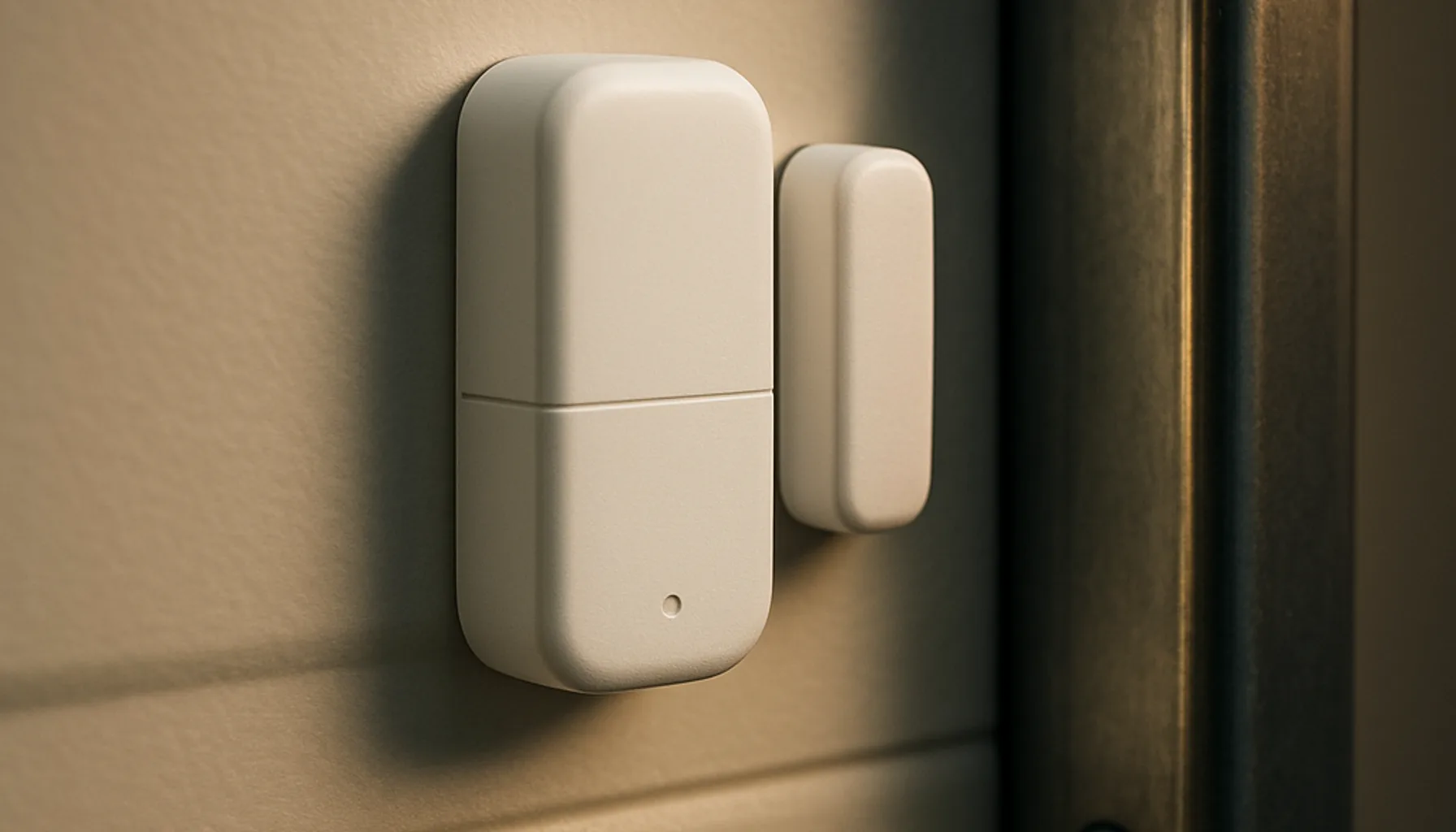
Short answer: the Aqara Door and Window Sensor (MCCGQ11LM) is the best garage door sensor for Home Assistant in 2026 — cheap, battery-powered, instant open/closed states over Zigbee, no hub, no cloud. For a sectional garage door, add an Aqara Vibration Sensor (DJT11LM) if you also want a reliable “moving” state. That is exactly the combo we run on our garage-door monitor, and it has been rock solid.
What we run
Our garage-door monitor uses an Aqara Door and Window Sensor with the magnet on the inside of the lowest panel and the contact on the wall opposite. The Aqara Vibration Sensor sits on a middle panel, below the rail, where it catches motor and rail vibration while the door travels. Both pair with Zigbee2MQTT in under a minute, and both report into the same Home Assistant instance as the rest of our 46-device Zigbee network.
Why two sensors and not one? Because a garage door has three states, and one sensor type cannot honestly cover all of them. The contact gives you a perfect binary “open or closed”. The vibration sensor gives you the “it is moving right now” signal that makes notifications and cover entities feel correct. The full build — including why we dropped a camera-AI idea for this job — is in our garage door monitor build log.
Contact sensor vs vibration sensor for a garage
| Sensor | Best for | Honest limit |
|---|---|---|
| Contact (reed) | Open/closed accuracy, instant state change | Tells you nothing about movement between the two states |
| Vibration | Detecting motion, tilt, door-is-moving | No absolute open/closed position; sensitivity needs tuning |
For a sectional door, mount the contact at the bottom panel: the lowest panel moves first, so contact breaks the moment the door starts opening. For a single tilt-up door, a tilt-capable vibration sensor on the panel works better than a reed, because the panel rotates instead of sliding past a fixed point. And for a slide gate, the contact on the gate plus vibration on the motor housing covers both state and movement.
The mistake people make is buying a contact sensor and calling it a motion detector. It will not tell you “the door is opening” — it will only flip from closed to open. If you automate lights, cameras or a closing timer, the moving state is the difference between a nice log and an automation that actually behaves.
Our pick: the Aqara door sensor (MCCGQ11LM)
- Instant, accurate states. The reed reports open/closed immediately over Zigbee; our Home Assistant sees the change in under a second.
- Battery for a year, not weeks. It only wakes on state change, and the CR2032 lasts well over a year in our setup.
- Works with ZHA and Zigbee2MQTT out of the box. No Aqara hub, no account, no app — pair and go.
- Small and magnetically forgiving. The two halves snap together, so a few millimetres of misalignment is fine.
- Honest price. €12–15 per unit is what a reliable, local garage sensor costs. Skip the “smart home” branded doubles.
The one genuine gripe is the small magnet gap: on a very thick or uneven frame you have to fiddle with alignment. For garage doors that is rarely a problem because you mount on the flat panel face, not a thick edge.
When to add the vibration sensor (DJT11LM)
Add the vibration sensor when you want the third state — “moving”. It detects vibration, tilt and drop, and that is what turns a binary contact into a believable cover entity:
- Sectional door: contact for position, vibration for motion, template cover combines both.
- Tilt-up door: use the tilt axis as your primary open/closed signal.
- Gate or barn door: movement on the motor, contact on the door.
One honest caveat: sensitivity tuning is a learning curve and user reviews are mixed on how tunable it feels. Buy it for a specific project, not as a guaranteed universal trigger. We use it in the garage-door build with exactly that nuance — and for our use case it earned its place.
Wiring it into Home Assistant
Pair both sensors in Zigbee2MQTT or ZHA, then create a template cover entity that maps the binary inputs to open, closed, opening and closing:
- Contact open + no vibration →
open - Contact closed + no vibration →
closed - Contact transition + vibration →
openingorclosing(vibration timestamp decides direction)
This gives you one clean “Garage Door” entity in the UI, ready for notifications (“garage left open”), timers and camera triggers — and it does not go stale if one battery dies, because you still have the other signal. The full YAML approach is in the build log, and the sensor choice details are in our door & window sensor guide.
Verdict
The Aqara Door and Window Sensor (MCCGQ11LM) is the best garage door sensor for Home Assistant in 2026: accurate open/closed states, year-plus battery, fully local, and cheap enough to spare. Add the Aqara Vibration Sensor (DJT11LM) only when you need the moving state — for a sectional garage door that is exactly the combo we run, and we would buy the same two sensors again today.
Prices and availability checked 2026-10-05. Commissions are earned from qualifying purchases — see our affiliate disclosure.