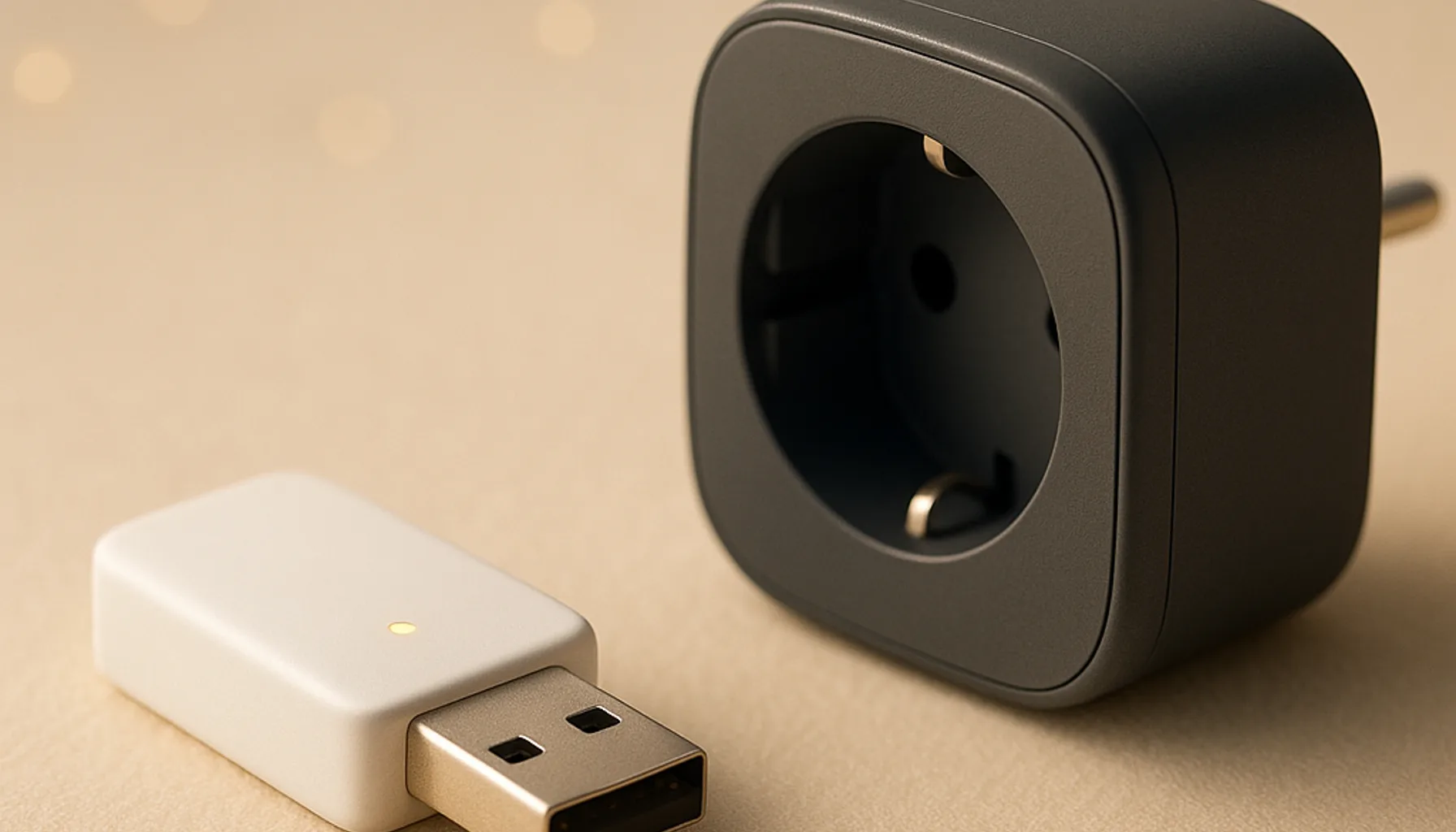
Short answer: If you are building a smart home in 2026, buy Zigbee devices. It is a mature, open, local-first mesh protocol with thousands of compatible products and rock-solid Home Assistant support. Matter is the industry’s new interoperability standard — promising, but younger: fewer devices, more setup friction, and its best radio (Thread) still needs new hardware. You don’t need to wait for Matter to start — and you don’t need to avoid it either. Here’s why.
Zigbee vs Matter: the 30-second version
| Zigbee | Matter | |
|---|---|---|
| What it is | A radio protocol + device language | An application standard (runs on top of radios) |
| Radio | IEEE 802.15.4 mesh | Thread, Wi-Fi or Ethernet |
| Ecosystem size | Thousands of devices, 15+ years of history | Growing fast, but still young |
| Home Assistant support | Excellent (ZHA / Zigbee2MQTT) | Good, native, but less battle-tested |
| Local control | Yes, no cloud needed | Yes, local by design |
| Best for | Buying a smart home today | Multi-ecosystem homes (Apple + Google + Alexa) |
If you only remember one line: Zigbee is a proven radio network; Matter is a promise that every ecosystem will speak the same language. They are not rivals you must pick between forever.
What each word actually means
Let’s clear up the jargon, because “Zigbee vs Matter” is really three words that people mix up.
Zigbee is a low-power mesh radio protocol built on IEEE 802.15.4. One device (the coordinator) manages the network, mains-powered devices act as repeaters, and battery sensors sleep to save power. It is open, mature, and completely local — no cloud account required. In practical terms: it’s the technology that most affordable smart plugs, sensors, and switches use today.
Matter is an application-layer standard created by the Connectivity Standards Alliance (CSA) — the same body behind Zigbee. Matter defines how devices from different ecosystems (Apple Home, Google Home, Alexa, Home Assistant) talk to each other. It is not a radio: Matter runs over Thread, Wi-Fi, or Ethernet. You can read the official framing at csa-iot.org/all-solutions/matter/.
Thread is an IP-based mesh radio (built on IEEE 802.15.4 like Zigbee) designed as the preferred transport for Matter over radio. Think of it as the road; Matter is the traffic rules; a border router is the toll booth connecting Thread to your Wi-Fi network. Thread Group’s official explainer is at threadgroup.org.
A useful analogy: Zigbee is a car brand you buy today; Matter is a road-traffic treaty; Thread is one of the highways the treaty can use. A treaty doesn’t put cars in your driveway — devices do.
What we run, and what we can honestly tell you
Our home runs a 46-device Zigbee network on a SONOFF ZBDongle-E coordinator with Zigbee2MQTT and Home Assistant. Every practical recommendation in this guide is grounded in that setup — it has been running for months, through coordinator migrations and dead-zone fixes, and it is what we would buy again tomorrow.
Here’s the honest part: we do not run a Matter household 24/7 yet. Matter and Thread support in Home Assistant works (there’s a native Matter integration), but our advice on Matter is based on the specification, the current device market, and the wider community experience — not on a year of daily Matter use. When something below is “on paper”, we say so.
Where Matter wins (and where it’s not there yet)
Where Matter genuinely wins:
- Cross-ecosystem, one app. A Matter device can be controlled by Apple Home and Google Home and Alexa at the same time, without vendor lock-in. That’s a real problem solved.
- Local by design. Matter doesn’t require a cloud, which aligns with the privacy-first way we run our home.
- One standard, one setup. Eventually, “does it work with my system?” stops being a question.
Where Matter is not there yet (2026):
- Device selection. The EU shelves are still dominated by Zigbee (and Wi-Fi) devices. Matter plugs and sensors exist, but the variety you get with Zigbee — especially quirky, affordable stuff — isn’t there.
- Firmware and version fragmentation. Matter 1.x keeps evolving; older devices sometimes need re-pairing after updates. That’s exactly the “firmware lottery” frustration we’re used to, just in a new wrapper.
- Thread commissioning is still fiddly. For a newcomer, pairing a Thread device (border router, network credentials, code scanning) is more steps than pressing the pair button on a Zigbee dongle.
- Price. Matter/Thread gear still carries a premium for the same basic function.
- Home Assistant maturity. ZHA and Zigbee2MQTT are boring, reliable, and covered by a decade of forum threads. The Matter integration is good but young in comparison.
Which protocol should you build on in 2026?
If you’re starting now with Home Assistant → buy Zigbee. It’s the cheapest, most flexible, best-documented path. You need a coordinator: either a USB dongle (SONOFF ZBDongle-E) for simplicity, or an Ethernet/PoE unit like the SMLIGHT SLZB-06 if you want it away from the PC’s USB noise (a USB 2.0 extension cable fixes most interference cheaply for the dongle route). Then follow our Home Assistant Zigbee Starter Guide.
If your life is Apple Home + Google Home + Alexa → keep an eye on Matter. Try a single Matter device this year and see if the multi-app magic matters to you. Just don’t replace a working setup for it.
If you already own Zigbee stuff → keep it. You are not locked out of the future: Home Assistant can bridge Zigbee into Matter with its Matter bridge, so your existing network can be exposed to Matter apps without buying anything.
The key insight: Home Assistant is a polyglot. It speaks Zigbee, Z-Wave, Matter, Thread, Wi-Fi, and a dozen more. Choosing Zigbee today does not close any doors — it just means you start with the most reliable option.
Bottom line
In 2026, the honest answer to “Zigbee or Matter?” is: buy Zigbee, watch Matter. Build your network on the mature protocol — a ZBDongle-E or SLZB-06 plus 46-devices’ worth of proven gear — and let Home Assistant translate to Matter whenever you add a device that speaks it. You’ll have a working, local, open smart home now, with a clean path to whatever the industry agrees on next. Compare with Zigbee vs Z-Wave if you’re weighing other mesh options too.
Prices and availability checked 2026-10-02. Commissions are earned from qualifying purchases — see our affiliate disclosure.