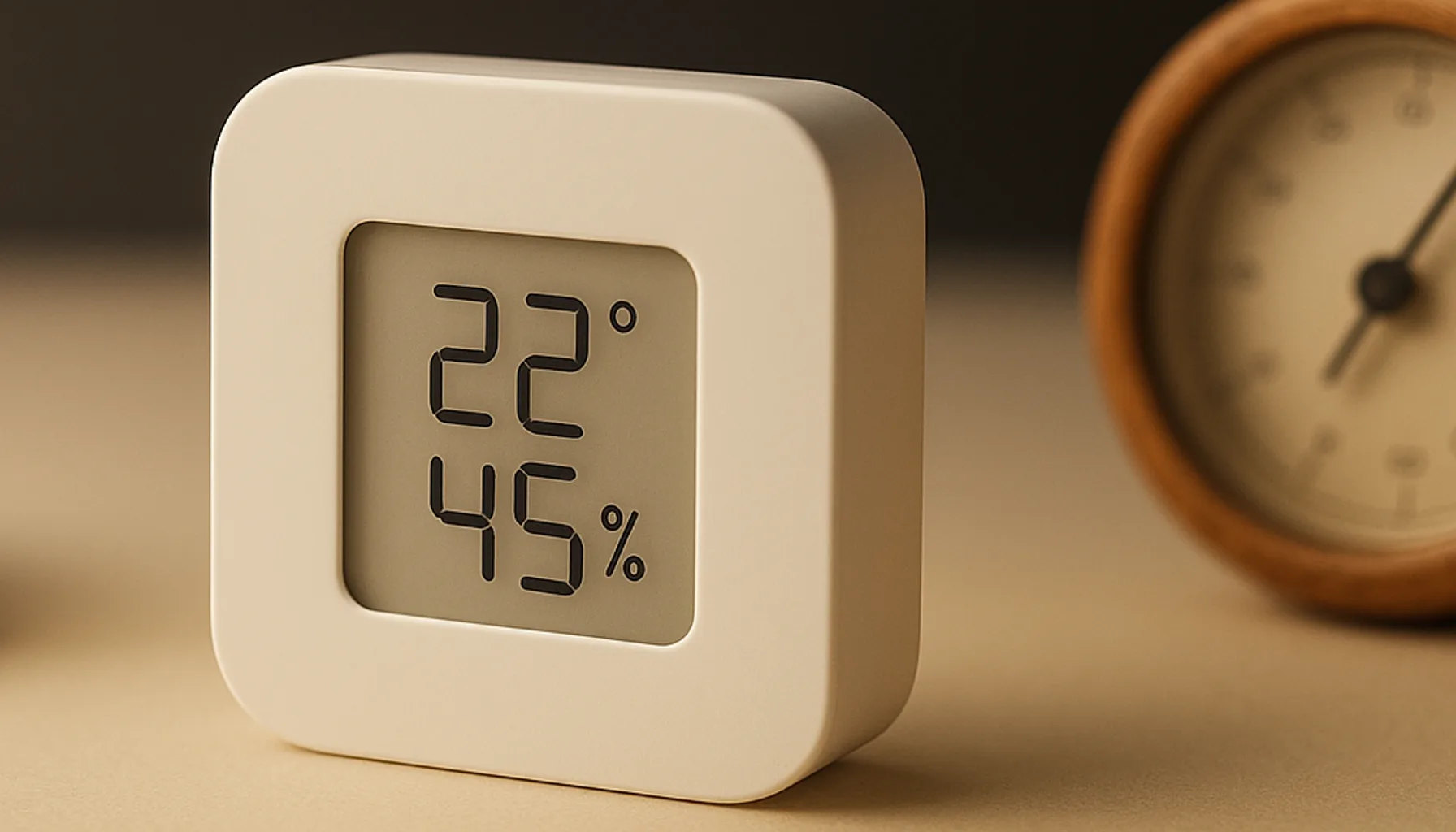
Short answer: if you want a single sensor that reports both temperature and relative humidity to Home Assistant, the SONOFF SNZB-02D is the 2026 all-in-one pick. It’s a Zigbee 3.0 sensor with an on-device display, a documented ±0.2 °C / ±2 %RH accuracy claim, and it pairs over ZHA or Zigbee2MQTT without any vendor hub — typically around €13–18. That “one device, two readings, no lock-in” combination is what makes it the sweet spot for heating, ventilation and comfort automation.
Why buy an all-in-one at all
On paper, two dedicated sensors look more flexible: a hypersensitive temperature unit here, a separate humidity unit there. In practice, most smart-home temperature and humidity use cases want the same reading of the same spot, at the same instant — and an all-in-one gives you that for the price of one device and one battery.
The real repeated use cases we keep seeing:
- Heating control — a single entity reports 21.4 °C and 48 %RH together, so a thermostat or a “windows open” check can act on both in the same automation.
- Condensation and comfort — dew-point and heat-index math needs concurrent temperature and humidity; two sensors that sample at slightly different times add noise.
- Trend logging — one device written to your database keeps temperature and humidity histories aligned by construction.
If you only care about temperature, a dedicated best temperature sensor guide applies; if you only care about humidity, the humidity guide is the one. This guide is for the common case where you want both from one unit.
What we run
Our 46-device Zigbee network uses a Sonoff ZBDongle-E coordinator running Zigbee2MQTT, and the SNZB-02D family is a documented, long-running part of our climate setup — it’s the same unit we call out in our temperature sensor guide and humidity sensor guide. We log its temperature and humidity entities over time and act on both, which is exactly the all-in-one workflow this guide is about.
To be straight about honesty: the SNZB-02D’s accuracy figures come from the official spec sheet, cross-checked against the consistent review matrix across the EU marketplaces (typically around 4.3 stars, sold by Amazon). Our own units track room conditions faithfully, but we don’t run a calibrated reference rig beside them — treat “±0.2 °C / ±2 %RH” as a credible, not a lab-proven, figure.
The shortlist
| Sensor | Zigbee | Display | Accuracy (claim) | HA via Z2M/ZHA | Price (approx.) |
|---|---|---|---|---|---|
| SONOFF SNZB-02D | 3.0 | Yes | ±0.2 °C / ±2 %RH | Yes, no hub needed | €13–18 |
| SONOFF SNZB-02 (non-LCD) | 3.0 | No | same sensor core | Yes | €10–14 |
| Aqara WSDCGQ11LM | 1.2/3.0 | No (older model) | ~±0.3 °C / ±3 %RH | Yes, but no reliable EU Amazon listing | €12–16 |
The SNZB-02D wins on the combination that matters for an all-in-one: a display so you can glance at the current reading, Zigbee 3.0 for a clean mesh join, and a paired temperature + humidity entity set that ZHA and Zigbee2MQTT expose immediately. The cheaper SNZB-02 drops the display but keeps the same sensor core — a fine budget option if you never read the device itself. The classic Aqara WSDCGQ11LM is a solid older sensor, but on EU Amazon only clones and third-party resellers reliably carry it, so we don’t link it — if you want it, buy it from an official Aqara channel.
What to do with the data
A temperature and humidity sensor earns its keep in automations, not in dashboard numbers. The three we use most:
- “Open the window” check — when indoor and outdoor dew points line up and indoor humidity is high, Home Assistant tells us to open the window instead of running a dehumidifier.
- Boiler / heating assist — using both readings so a room gets topped up for comfort without overcooking humidity.
- Bathroom exhaust logic — trigger the fan on a rising humidity trend, not on a single reading, so it stops once the condensation risk has passed.
All three need a sensor that reports both numbers over time; an all-in-one keeps that simple. Pair next to the coordinator first, let it join the mesh, then move it to its final spot — the same placement playbook as our Zigbee range guide.
The honest caveats
- Accuracy claims are spec-sheet, not lab-verified. We rank from the official figures and the review matrix, and our units behave as expected — but don’t treat ±2 %RH as a calibrated instrument.
- Battery is the recurring cost. Zigbee sensors that report on a schedule drain faster than pure on-change devices; budget a CR2032/CR2450 refresh, and put the display model where the battery is easy to reach.
- Placement changes the reading. Near a radiator, a window or direct steam, the same sensor reads wildly differently. For a meaningful all-in-one reading, keep it on open-air flow, away from heat and drafts.
- Don’t cross-marketplace assumptions. The same EU listing on amazon.co.uk/.de/.nl usually carries the same product, but double-check that the seller is SONOFF/Amazon and the item is the “LCD” version before you buy.
Verdict
Buy the SONOFF SNZB-02D if you want one Zigbee sensor that reports temperature and humidity together for Home Assistant: a display, an honest ±0.2 °C / ±2 %RH spec, clean ZHA or Zigbee2MQTT pairing and a price that undercuts buying two separate units. Dedicate it to a spot, feed both entities into the same automation, and let the trend do the work.
Prices and availability checked 2026-10-21. Commissions are earned from qualifying purchases — see our affiliate disclosure.