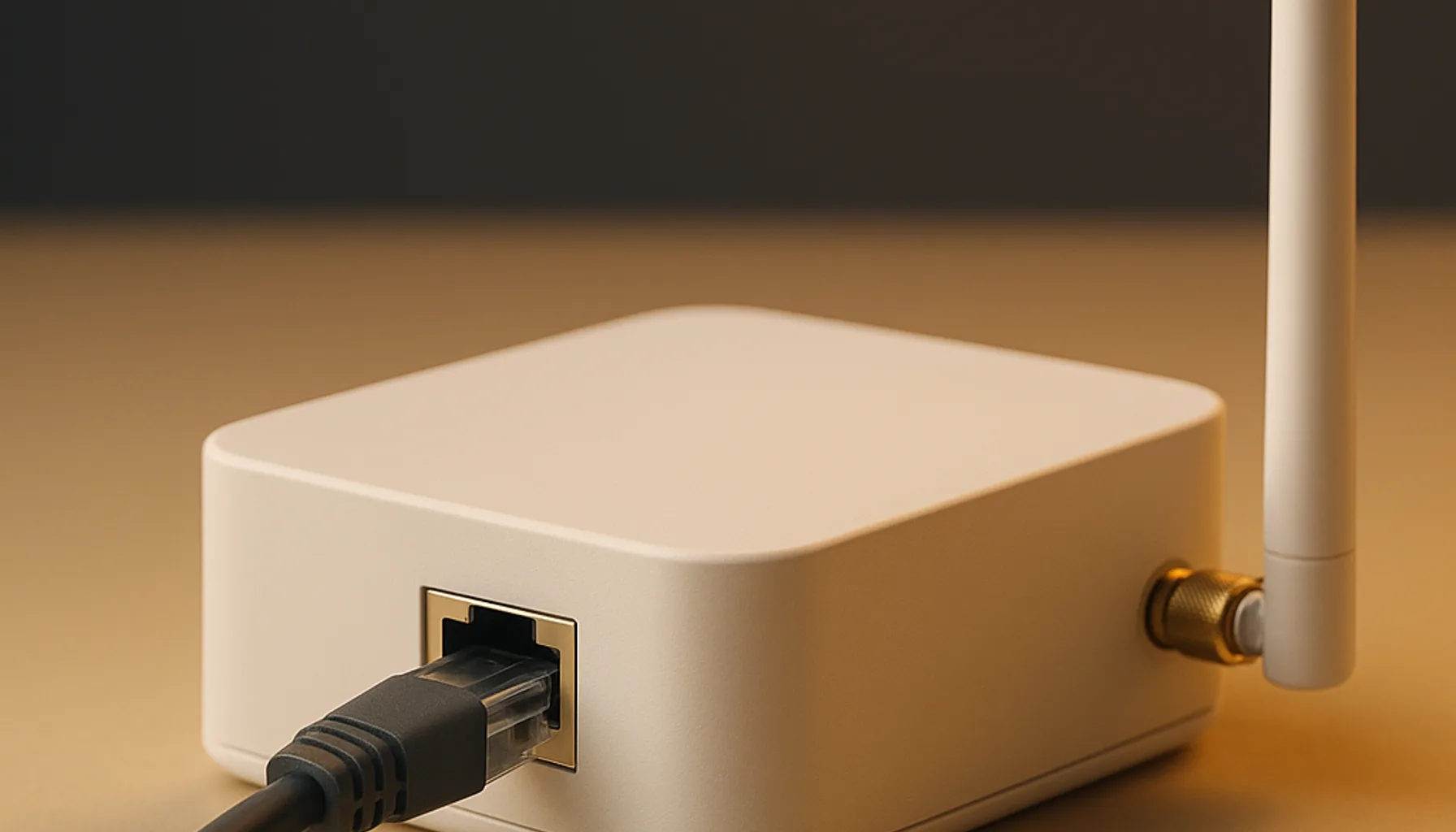
Short answer: for the specific buyer who has already decided to get the coordinator off a USB cable, the SMLIGHT SLZB-06 is the Ethernet/PoE coordinator to buy in 2026. It’s a mature, firmware-fixable box — not a dongle — and it’s the pick when the real problem is where the radio has to sit. But be sceptical of the pitch: an Ethernet box costs 3× a USB stick and fixes only one thing (placement), not a thin mesh. If you haven’t hit a placement wall yet, the Sonoff ZBDongle-E still makes more sense for almost everyone.
Why go Ethernet/PoE at all
Skip the marketing. An Ethernet coordinator exists for one reason: to move the Zigbee radio away from the box that hosts Home Assistant. A USB stick has to live within a short cable of the server — often a rack, closet or garage where the 2.4 GHz band is crowded and the mesh has to reach through walls from a bad spot. Ethernet untethers the radio: one cable or a PoE injector, and the coordinator sits in the middle of the house where the mesh actually needs it.
There’s a legitimate second reason: hypervisors. On Proxmox, ESXi or a NAS, USB passthrough is the single flakiest thing in a smart-home stack. An IP address is just an IP address. For that setup, LAN-coordinator sentiment is not hype — it’s experience shared across the Home Assistant forum.
The 2026 Ethernet shortlist
| Device | Chipset | Best for | Price (approx.) |
|---|---|---|---|
| SMLIGHT SLZB-06 | EFR32MG24 | Whole-home Ethernet/PoE, placement-driven | €60–85 |
| TubeZB MGM21 / MG21 | EFR32MG21 | Ethernet coordinator, power-user config | €60+ |
| Sonoff ZBDongle-E (USB fallback) | EFR32MG21 | Most people who don’t need Ethernet | ~€20–27 |
The SLZB-06 is effectively the default of this niche: the chipset used in most modern guides, PoE as standard, and firmware that’s actually updateable instead of a stick you flash and hope. The TubeZB path exists for people who want more control, but it demands more setup and a deeper spade. For the buyer, the SLZB-06 is the option with the least sharp edges.
What you give up going Ethernet
I’d want this list in bold before anyone buys.
- Cost. Roughly 3× a USB dongle for the same chip-level job, plus a PoE injector or switch if you don’t have one.
- A network dependency. Your Zigbee now dies with your switch and needs a powered PoE source. For most homes that’s fine; for a “network is down, door won’t open” worst case, know it.
- Setup sprawl. IP address, TCP in Zigbee2MQTT or a ZHA socket, a separate power path. It’s minutes of work, but it’s more moving parts than “plug in one stick”.
- It doesn’t fix the mesh. This is the one everyone trips on. A better coordinator in a worse spot is still worse than a cheap stick placed well. Router density — mains-powered bulbs, plugs — decides range, not the box on the wall.
The honest caveats
We run 46 Zigbee devices on a ZBDongle-E over USB in our own home, and the Ethernet side of this ranking is built from specs, teardowns and community reports (the Home Assistant forum’s USB vs LAN discussion, the “perfect Zigbee coordinator doesn’t exist” thread) — not from running an SLZB-06 as our daily driver for years. Two firmware versions of the SLZB-06 get explicitly flagged to skip in community threads; whatever you buy, update the firmware before pairing everything.
Which Ethernet coordinator should you buy?
| Your situation | Verdict |
|---|---|
| Server in a rack/closet, 30+ devices | SMLIGHT SLZB-06 over PoE |
| On Proxmox/ESXi, sick of USB passthrough | SMLIGHT SLZB-06 — one IP, done |
| Coordinator must live in the middle of the house | SMLIGHT SLZB-06, run one cable |
| You just want it to work, have no placement pain | Sonoff ZBDongle-E — don’t overbuild |
The pattern is consistent: buy the SLZB-06 only when placement or hypervisor passthrough is the actual constraint. Otherwise you’re paying 3× to solve a problem you don’t have.
Bottom line
If your network’s problem is where the coordinator sits, the SLZB-06 is the Ethernet/PoE coordinator we’d buy in 2026 — update the firmware first, put it where the mesh needs it, and power it over PoE so it stays up on its own. If you’re not there yet, save the money and run the ZBDongle-E on a USB extension, then read our coordinator migration guide before you ever swap hardware — that step saves you from re-pairing a whole network.
Prices and availability checked 2026-10-14. Commissions are earned from qualifying purchases — see our affiliate disclosure.