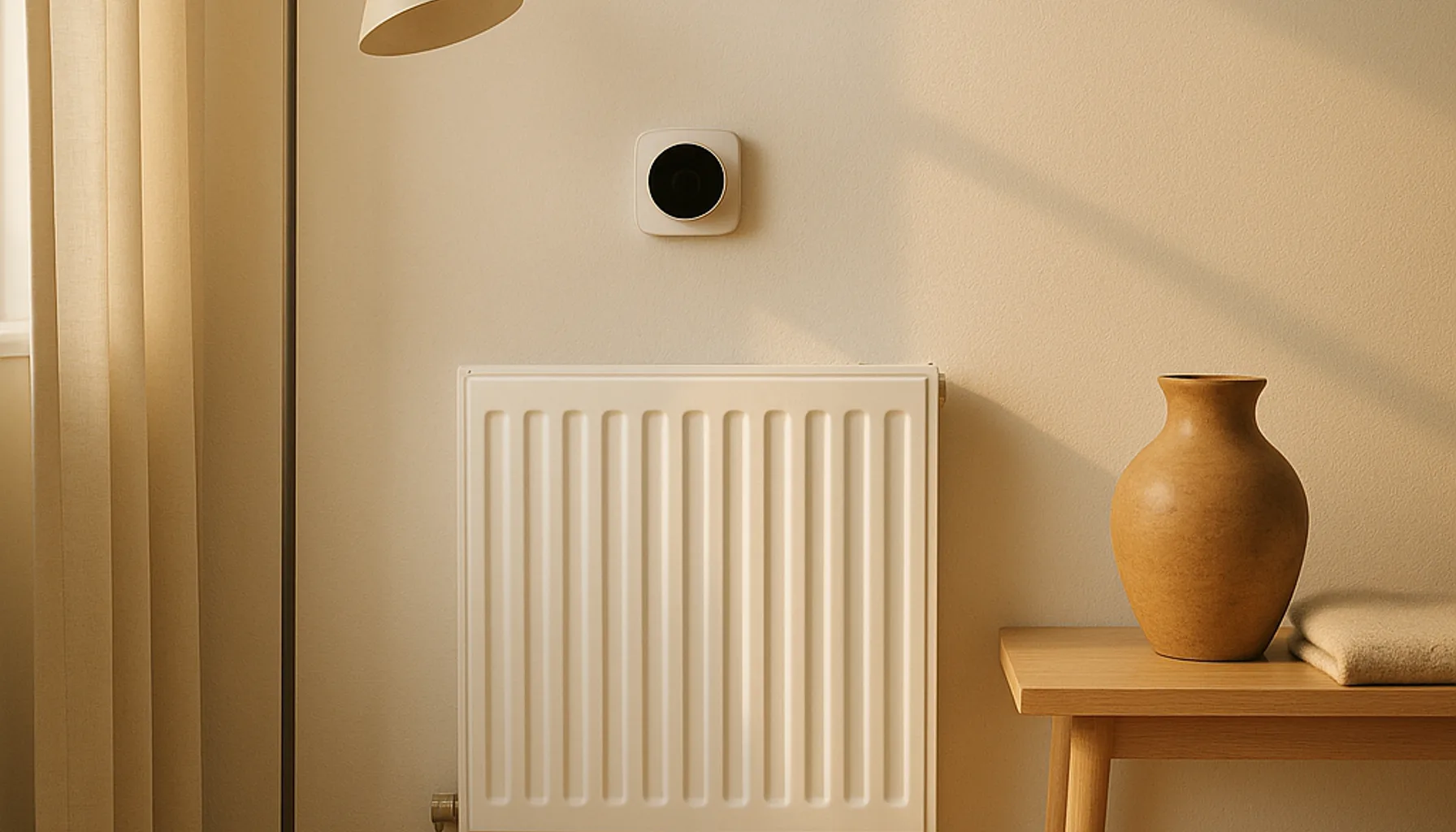
Short answer: a rental flat rules out exactly one thing — touching the fixed wiring — and almost everything worth having does not need it. The kit that works: a Zigbee coordinator in a USB socket, radiator valves that screw onto the existing M30 thread, smart plugs for lamps and heaters, and battery sensors that stick on with tape. Nothing drilled, nothing rewired, and every piece unscrews in an afternoon when you move out.
I rent-proofed my own setup the hard way: I built the full thing in a house I own, then stripped it back to “what would survive a landlord inspection”. This is that list.
What a rental rules out (and what it doesn’t)
The line is simple: anything behind the plaster is out. No relay module in a switch box, no new wall plate, no ceiling light rewiring, no thermostat swap on a gas boiler. Those are the changes a landlord can object to, and they are also the ones that cost money to undo.
Everything on the other side of that line is fair game:
- devices that plug into a socket (coordinator, smart plugs),
- devices that screw onto an existing fitting (radiator valve heads),
- devices that stick on (door, motion, temperature, leak sensors),
- and the software that ties them together, which lives on your own hardware and leaves with you.
That is not a compromise kit. In a flat, the two things people actually complain about — a bedroom that is too hot while the hallway is cold, and lights that need a walk to the switch — are both solvable with plug-in and screw-on devices only.
The three rules I stick to
- Nothing that needs a screwdriver in the wall. If a device needs a hole, it does not go in. This one rule removes 90% of the arguments.
- Everything must come off in one afternoon. If moving out would mean patching, painting or an electrician, I don’t install it. Removable adhesive, screw-on valves, plugs: all fine.
- Buy devices that are yours, not the flat’s. A TRV head or a sensor goes in a box and comes to the next place. A rewired switch stays behind and is money gone.
Heating: the radiator valve is the big win
If your flat has a central boiler you don’t control, the radiator valves are where the comfort is. A Zigbee TRV replaces the plastic head on the radiator — it unscrews, the new one screws on, and the old head goes in a drawer until you leave. No plumbing, no water on the floor, no landlord conversation.
The SONOFF TRVZB is the one we recommend for this: standard M30 x 1.5 thread plus adapters for the common Danfoss and RA valves, two AA batteries, and it reports the actual valve position to Home Assistant. For a flat with three or four radiators, the 4-pack is the cheaper way to buy it — in our 23 November 2026 price check that listing sat in the €80+ band on amazon.de, which is still less than four singles.
Two honest caveats, because I have not installed one of these myself: check your valve thread before ordering (photograph the head, measure, or look up the valve model), and expect the motor to be audible in a bedroom at night when it repositions. Both are in our TRV guide in more detail.
Sockets and lamps without touching the wiring
The floor lamp, the desk lamp, the panel heater, the Christmas tree: all of it goes through a plug. The SONOFF S60ZBTPF is what we run at home — it switches, it reports watts, and because it is mains-powered it also strengthens the Zigbee mesh, which matters in a flat with thick walls and a nosy neighbour’s Wi-Fi.
This is the part of the kit with zero risk and zero permission needed. Plug it in, pair it, done. When you move, it goes in the box with the rest.
Sensors that stick instead of screw
Battery sensors are the renter’s best friend: no wiring, no holes, and they run for a year or more on a coin cell.
- Doors and windows: the Aqara Door and Window Sensor is the one we use — it comes with adhesive plates, so the sensor sits on the frame and the magnet on the door. Put the tape on clean paint, not on wallpaper, and use a removable adhesive strip if you care about the deposit.
- Motion and presence: for a hallway, a PIR sensor on a shelf beats anything that needs a cable.
- Temperature and humidity: one per room is enough to see why the bedroom is cold; it also feeds the heating automations.
The one thing to check before you stick anything on: fresh paint and cheap adhesive do not mix. Wait a week after painting, or use the removable strips.
The coordinator: the one thing you plug in and forget
Every Zigbee device needs a coordinator, and this is the part renters get wrong by buying a vendor hub. A USB stick — the SONOFF ZBDongle-E is what runs our network — goes into the machine running Home Assistant, ideally on a short USB extension cable so it is not sitting in a USB 3 port’s noise. No mounting, no screws, and it moves with you.
That also means the whole brain of the flat is yours: the automations, the history, the backups. Nothing is tied to an account you would have to abandon.
What I would buy first, in order
- The coordinator — nothing else works without it.
- One smart plug — the cheapest way to prove the network works and to get a power sensor in the same purchase.
- One door sensor — an instant, visible automation (“hallway light on when the front door opens”) that sells the idea to whoever else lives there.
- The radiator valves — the biggest comfort win, and the one purchase that pays for itself in a flat with a boiler you can’t schedule. Buy the 4-pack if you have three or four radiators.
That order is deliberate: each step is cheap enough to be reversible, and each one teaches you something the next step depends on. The full kit for a one-bedroom flat lands somewhere around €150–200, spread over a few months, and every piece of it comes with you when you leave.
The honest verdict
A rental flat is not a smart-home dead end — it just moves the devices out of the walls. Valves, plugs and stick-on sensors cover heating, lighting and alerts, which is most of what a home automation system is actually for. What you give up is behind-the-switch control and anything that needs a permanent cable, and in a flat that is a smaller loss than it sounds.
Start with the coordinator and one plug, add sensors as you find annoyances, and put the money you would have spent on relays into radiator valves instead. Then, when you eventually buy a place, the only thing that changes is that you can finally put modules behind the switches — with a network and a set of automations that are already two years old.