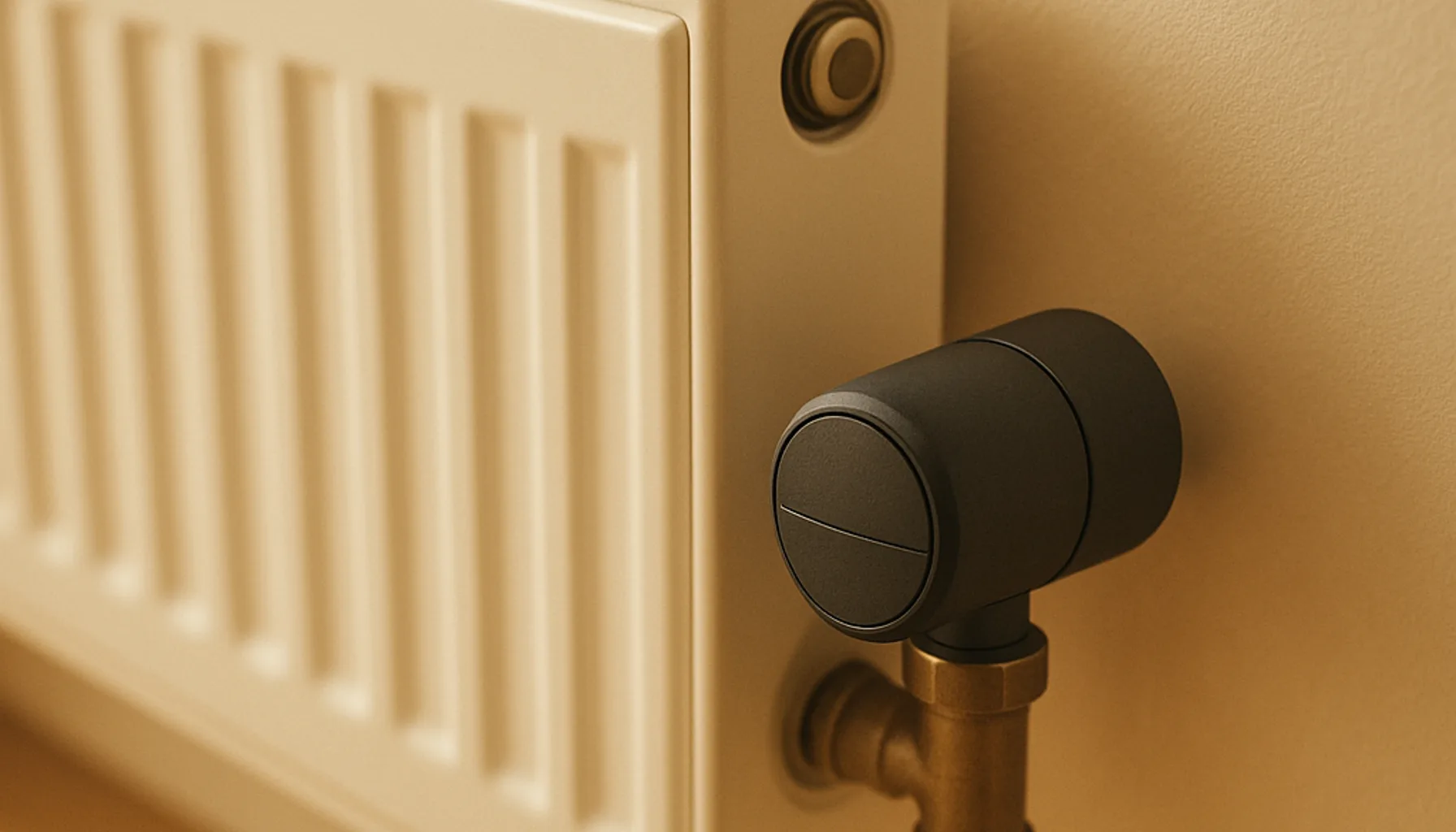
Short answer: if you want room-by-room heating that Home Assistant can actually control, buy a Zigbee TRV (thermostatic radiator valve) — the SONOFF TRVZB is the one I’d start with, and the 4-pack is the version that makes sense for a whole flat. It is a battery-powered valve head that replaces the plastic knob on your radiator, it costs less than a single “smart thermostat”, and it gives you the thing a central thermostat can never give you: a different temperature in every room, on a schedule, without touching a boiler.
I’ll be straight about one thing before we go further. We have not installed TRVs on our own radiators. Our heating setup is a panel heater on a 16 A Zigbee plug plus a frost-alert automation built on Zigbee temperature sensors — both written up on this site. So this guide is research-based: manufacturer specs, the Zigbee2MQTT/ZHA device support, and the failure reports that come up again and again in owner threads. The automation examples below are the ones I would run, in the same shape as the automations we do run.
Why a TRV is the cheapest way to heat room by room
A central thermostat measures one room and heats the whole house to that number. That is a fine design if every room has the same job. Most homes don’t: the bedroom wants 16 °C at night, the bathroom wants 22 °C at 07:00, the spare room wants to be left alone.
Three ways to fix that, in order of cost:
- Manual TRVs on every radiator. Free, works, and you will never touch them consistently.
- One smart thermostat plus smart TRVs. Good, expensive, and the boiler side needs wiring you may not have.
- Smart TRVs only, boiler untouched. Cheapest real option. The boiler keeps running on its own schedule or on demand; the valves decide which radiators are allowed to heat.
The third option is what this guide is about, and it’s the one that fits a rental, a flat with a shared boiler, or a house where the thermostat is in the hall and the hall is always cold.
What we actually run (and why it matters for this guide)
Our own heating automations are small and boring, and that is on purpose:
- A SONOFF S60ZBTPF plug on a panel heater, used to cut power when nobody is home or a window is open — not to be the thermostat.
- SONOFF SNZB-02D temperature and humidity sensors in the rooms that matter, reporting every few minutes into Home Assistant.
- A frost-alert automation that shouts at us when a room drops toward freezing.
That’s the pattern a TRV slots into: a sensor you trust, a rule that is allowed to say “no”, and a device that fails to the safe side. What we don’t have is a radiator valve, so I’m not going to invent installation anecdotes. Instead, here is exactly what I checked before recommending one.
The shortlist: one valve, two ways to buy it
| Option | What it is | Why it’s on the list | Rough price |
|---|---|---|---|
| SONOFF TRVZB | Zigbee 3.0 TRV, 2× AA batteries, M30 × 1.5 thread with adapters | The safe default: plain Zigbee, no hub of its own, works with Zigbee2MQTT and ZHA, and it’s cheap enough to buy one and test on the radiator you care about | €19–26 per valve |
| SONOFF TRVZB 4-pack | Four of the same valve | The whole-home version, and per valve it’s the cheapest way in. Also the version that makes the biggest difference to a heating bill, because one smart radiator in a house of five changes nothing | €96–104 for four |
| Aqara Radiator Thermostat W600 | Matter/Thread/Zigbee TRV | The interesting 2026 alternative if you’re building around Thread and Matter rather than Zigbee. We couldn’t confirm a Dutch listing when we checked, so no link — look it up per marketplace | €45–50 |
| Aqara Radiator Thermostat E1 | Zigbee TRV that needs an Aqara hub | Only makes sense if you already own an Aqara hub. Buy the W600 instead if you’re starting fresh | €40–45 |
Two notes before you order. First, the 4-pack is a different listing with its own price, and the per-valve price drops a lot — but only buy four if you have four radiators you actually want to control. Second, the Aqara E1 is the trap in this list: it needs an Aqara Zigbee hub, which is a €40–70 device you don’t need for the SONOFF. If your plan is “Zigbee coordinator + Home Assistant”, the SONOFF is the shorter path.
Check your valve before you buy anything
This is where most returns happen, so do it first. Turn the old knob to the highest setting, then unscrew it — on most European radiators it comes off by hand.
- M30 × 1.5 is the standard thread on the vast majority of radiators sold in the UK, NL and DE in the last 30 years. The TRVZB ships with this adapter.
- Danfoss RA / RAV / RAVL and a few older valves need a specific adapter. Most TRV boxes include them; check the box contents, not the marketing photo.
- If the pin under the knob is stuck, no smart valve will fix it. Push it in with a coin: it should move and spring back. If it doesn’t, that radiator needs a new valve insert before it needs a smart one.
You also need a Zigbee coordinator — a USB dongle or a network coordinator — and something to run Zigbee2MQTT or ZHA on. If you don’t have that yet, start with the coordinator guide, not with valves.
Pairing it: Zigbee2MQTT or ZHA
The pairing itself is the easy part: put the valve in pairing mode (hold the button until the display flashes), permit join in Zigbee2MQTT, done. What matters is what you get afterwards.
- Zigbee2MQTT exposes the valve position, the measured temperature, the setpoint, child lock, and — the part that actually matters — a way to feed an external temperature into the valve. That means the TRV stops trusting the air two centimetres from the radiator and starts following the sensor on the other side of the room.
- ZHA supports the same valve, but the exposed set is thinner and the quirk situation changes between releases. If you’re on ZHA, check the current device page before you buy four of them.
Practical detail: give each valve a name that matches the room, not the device (trv_bedroom, not trv_3f2a). You will be writing automations against those names for years.
The automations that actually save heat
Four rules cover almost everything. None of them are clever, which is why they keep working:
- Schedule per room, not per house. Bedroom 17 °C from 22:00, 19 °C from 06:30. Living room 20 °C in the evening. Bathroom 22 °C for an hour in the morning.
- Window open = valve off. A door/window sensor on the frame, and the valve closes while the window is open. This is the single automation that pays for itself fastest in a badly insulated flat.
- Away = 16 °C everywhere. One boolean, one automation, all valves. Frost protection stays on.
- Nobody home for two hours = setback. Presence from your phone or a motion sensor, then a lower setpoint.
A minimal version of rule 2, in the shape we run our heating automations:
automation:
  - alias: "Bedroom valve off while window is open"
    trigger:
      - platform: state
        entity_id: binary_sensor.bedroom_window
        to: "on"
        for: "00:02:00"
    action:
      - service: climate.set_temperature
        target:
          entity_id: climate.trv_bedroom
        data:
          temperature: 7
Seven degrees is not “off” — most TRVs treat very low setpoints as frost protection. That’s deliberate: it keeps the valve exercising instead of seizing shut over summer.
The catches nobody mentions
- Batteries are the maintenance. Two AA cells per valve, and a valve that moves a lot eats them faster. When a valve dies mid-winter it usually fails open, which is the expensive direction. Set a battery-level alert at 20% and keep spare cells in the drawer.
- The valve is not a thermometer. Mounted on the radiator, it measures the radiator’s neighbourhood, not your sofa. This is why the external sensor matters more than the valve’s own specs.
- Motor noise. TRVs make a short mechanical whirr when they move. In a bedroom at 06:30 you will hear it. It’s not loud, but it is not silent either.
- One valve is a gadget, five valves are a system. If you only automate the living room, you’ll spend the winter walking around turning the others down by hand. Budget for the rooms you actually use, or don’t start.
- Your boiler doesn’t get smarter. TRVs control radiators, not the boiler’s flow temperature. If your boiler runs at 70 °C all winter, a TRV can close a radiator but it can’t make the boiler condense properly. That’s a separate (and bigger) project.
Verdict
Buy one SONOFF TRVZB first, on the radiator in the room where the temperature argument happens — usually the bedroom or the home office. Pair it, add a temperature sensor on the other side of the room, and run the window-open rule for two weeks. If the room feels better and the valve hasn’t annoyed you, buy the 4-pack and do the rest of the house.
What I would not do: start with a €200 thermostat-plus-valves kit, or with a valve that needs its own hub. The point of a Zigbee TRV is that it’s a €20 decision you can reverse, on a system you already run. That’s the whole argument, and it’s a good one.