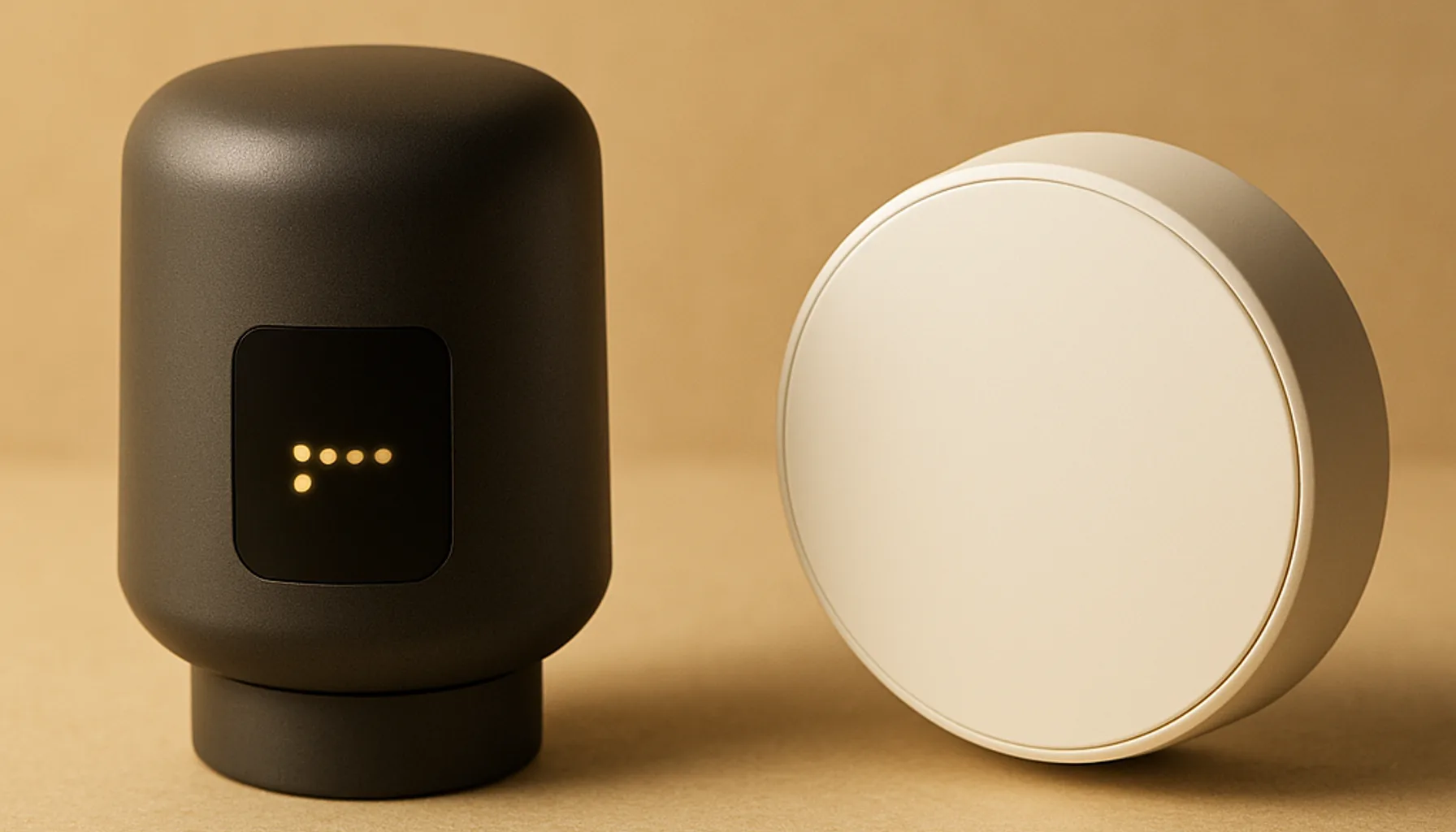
Short answer: a smart thermostat controls the boiler, a Zigbee TRV controls one radiator, and the two solve different problems. If you have a combi boiler and one room that is always wrong, buy TRVs first — per-room control is where the comfort and the savings are, and it’s the cheaper, reversible purchase. If your boiler runs constantly because nothing tells it to stop, the thermostat is the bigger win and the TRVs come second. For most homes in the UK, NL and DE the honest order is: TRVs on the rooms you use, then a thermostat if the boiler still misbehaves.
This is the comparison I wanted to read before buying anything, so it’s built the way we build our buying guides: criteria first, then what each option does against those criteria, then a verdict table. No invented savings percentages — heating numbers depend on your house, your boiler and your tariff, and anyone quoting “up to 30% saved” without your gas bill is selling something.
What each device actually controls
The confusion starts here, and everything else follows from it.
- A TRV is a valve head on one radiator. It decides how much hot water flows through that radiator. It cannot start the boiler, and it cannot stop the boiler.
- A smart thermostat replaces the room thermostat (or the boiler’s control interface). It decides whether the boiler runs at all, based on one temperature reading and a schedule.
- A TRV plus a thermostat is the only combination that can do both: the thermostat owns the boiler, the valves own the rooms.
So “which is better” is the wrong question. The right question is: which one is currently missing in your house? If your radiators have manual knobs that nobody turns, you’re missing room control. If your boiler has a 20-year-old dial thermostat in the hall, you’re missing boiler control.
The criteria that decide it
Five things decide this, in this order:
| Criterion | Why it matters | Favours |
|---|---|---|
| Number of rooms with different needs | Two or more rooms that want different temperatures = per-room control wins | TRVs |
| What the boiler does when nothing asks for heat | If it cycles constantly, boiler control is the bigger waste | Thermostat |
| Wiring you’re willing to touch | A thermostat replacement often means mains wiring; a TRV means unscrewing a knob | TRVs |
| Rental vs owned | A TRV comes off in five minutes; a thermostat install needs permission | TRVs |
| Existing ecosystem | Already running Zigbee2MQTT/ZHA? TRVs join for €20 each | TRVs |
If four of those five point the same way, you have your answer and you can stop reading. In our experience of writing these guides, they usually do — most people asking this question already have a Home Assistant setup and a radiator problem, not a boiler problem.
Where the central thermostat wins
Being fair to the other side: there are real cases where the thermostat is the correct first purchase.
- One open-plan space. If your living room, kitchen and dining area are effectively one room, per-room control buys you nothing. One good thermostat with a schedule is the whole job.
- Underfloor heating. A TRV is meaningless there; you need a manifold actuator and a thermostat that understands slow-response heating.
- A boiler that never modulates. An old non-condensing boiler running flat out on a hall thermostat wastes more than any radiator valve can recover.
- Heat pump installs. Flow temperature, weather compensation and hot-water priority are thermostat jobs, not valve jobs.
- You want one device and no maintenance. No batteries, no valves to re-pair, nothing to update.
Where TRVs win
And here’s why they win for most people who end up on this page.
- They fix the actual complaint. Nobody says “my boiler cycles oddly”. They say “the bedroom is freezing and the hall is boiling”. That’s a per-room problem.
- They’re reversible. No wiring, no landlord conversation, no boiler certification. Unscrew, screw back on.
- They scale in €20 steps. One valve this month, three more after Christmas. A thermostat is a single €150–250 decision with an installer attached.
- They work with the sensors you already own. A temperature sensor in the room beats the thermostat’s reading of the hallway, every time.
One thing to be clear about: TRVs don’t make your boiler more efficient. They make it run less often by closing radiators, which is a real saving in a house that heats empty rooms — and close to zero in a small flat that heats everything anyway. If your radiators are all in rooms you use all day, be honest that this is a comfort purchase.
The hybrid most people end up with
In practice, the setup that survives a winter looks like this:
- A coordinator (USB dongle or network coordinator) running Zigbee2MQTT or ZHA.
- TRVs on the radiators in the rooms with a schedule — bedrooms, office, bathroom. Not the hallway.
- A temperature sensor per room, away from the radiator, feeding the valve’s external temperature input so the TRV stops trusting the air next to the pipes.
- Window sensors so an open window closes the valve instead of heating the street.
- Later, maybe: a thermostat or boiler interface if the boiler still runs when nothing asks for it.
Step 3 is the one people skip, and it’s the one that decides whether the system feels smart or stupid. A TRV mounted on a radiator that is heating is measuring the radiator, not the room.
What we run, and what we don’t
Our own house runs Zigbee temperature and humidity sensors (SONOFF SNZB-02D) in the rooms that matter, a frost-alert automation that warns us when a room drops toward freezing, and a panel heater on a 16 A Zigbee plug that Home Assistant is only allowed to switch off. We have not installed TRVs on our radiators, so everything in this guide about valves is research-based: manufacturer specs, the Zigbee2MQTT/ZHA device support, and owner reports.
That’s also why the recommendation below is deliberately cheap. I’m not going to talk you into a €250 thermostat on the strength of a comparison I can’t test in my own house.
What I’d buy first, in what order
| Step | Buy | Why this order |
|---|---|---|
| 1 | SONOFF TRVZB, one valve | €19–26 to find out whether your radiator accepts a TRV, whether you like the noise, and whether the room actually feels better. One valve answers all three |
| 2 | SONOFF TRVZB 4-pack | Once one works, four valves cover a normal flat. Cheaper per valve than buying singles, and it’s the point where the heating bill can move |
| 3 | Room sensors (we use the SNZB-02D) | Turns the valves from “scheduled” into “actually measuring the room”. Skip this and you’ve bought remote-controlled knobs |
| 4 | A thermostat or boiler interface | Only if, after steps 1–3, the boiler still heats when nothing asks it to. That’s the case where the thermostat earns its price |
Notice what’s not on the list: a hub. If you’re running Home Assistant with a Zigbee coordinator, the TRVs join directly and the hub is a €40–70 device that adds a second app and a second failure point.
Verdict
TRVs first, thermostat later — that’s the order for most homes, and it’s the order that keeps you out of a €250 decision you might not need. Buy one valve, prove it on the radiator you actually care about, then scale in a 4-pack once the room feels right.
The exception is worth repeating: if your boiler heats all day regardless of what the rooms need, no amount of valves will fix that. In that house, the thermostat is the first purchase and the valves are the refinement.