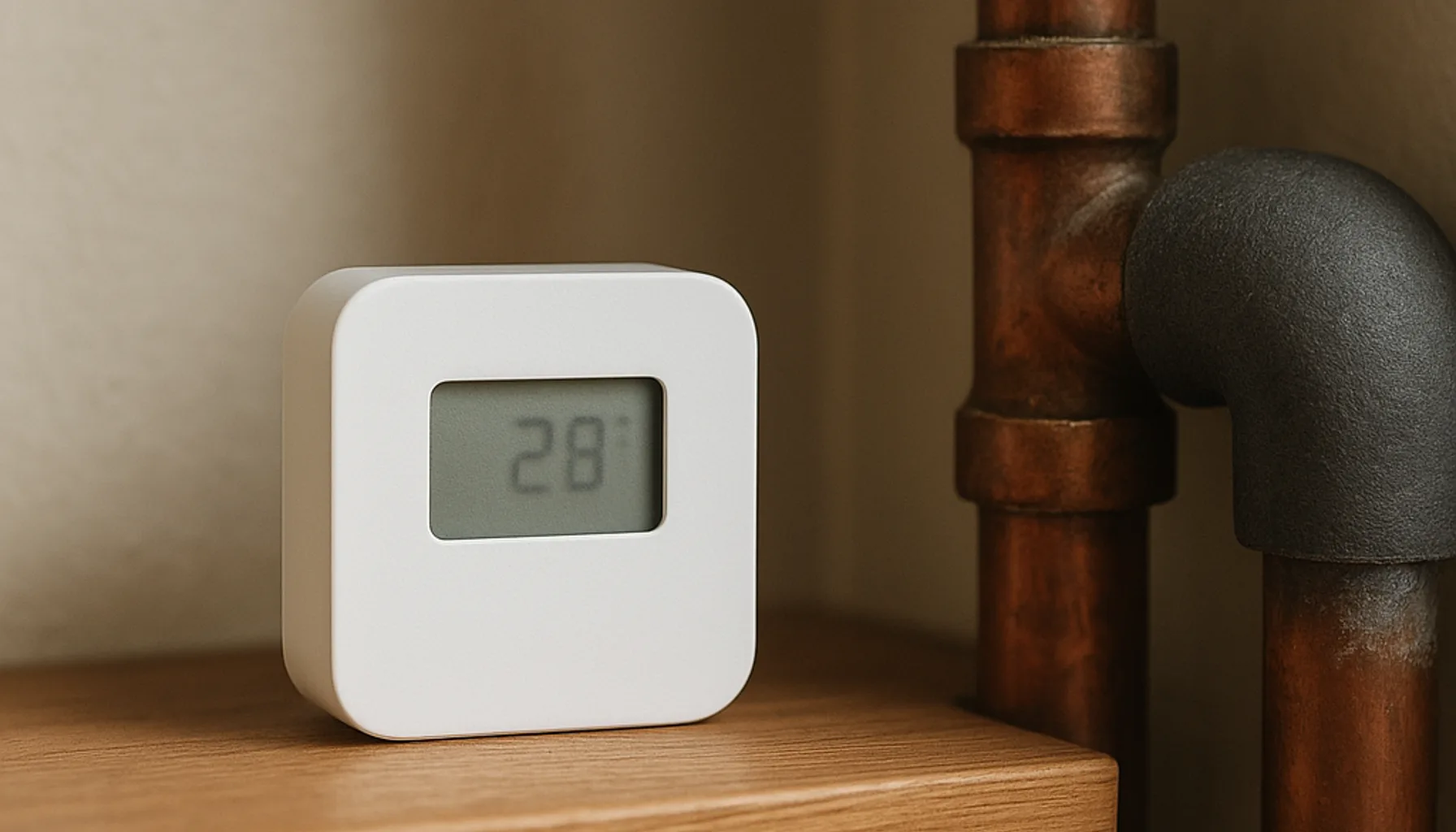
Short answer: a frost alert is one cheap sensor plus one automation, and it costs less than a single plumber call-out. Put a SONOFF SNZB-02D (a Zigbee 3.0 temperature and humidity sensor with a display, around €13–18) in the coldest spot in the house — not in the living room — and let Home Assistant warn you at +4 °C, then again at +1 °C. No hub, no subscription, no alarm company. If you want to go one step further, add a Zigbee plug in front of a small frost-guard heater so the house can react while you’re still asleep.
Let’s keep it simple, because this is a guide for people who have never wired an automation before: you’re not building a smart home here. You’re putting a €15 thermometer where the pipe is, and making it shout.
Why a frost alert is the cheapest insurance in the house
Water expands by roughly 9% when it freezes. That expansion has to go somewhere, and inside a copper or plastic pipe it goes into the pipe wall. The pipe splits, and — this is the part that surprises people — the damage often only shows up hours later, when the ice melts and the water finally has somewhere to go. By then it’s a ceiling, a floor and a wall.
The places that freeze are almost never the rooms you heat. They are the garage, the shed, the loft, the boiler cupboard on an outside wall, the cupboard under the sink against a cavity wall, and the holiday home where the thermostat sits at 8 °C from November to March. Insurance will usually pay for the repair. It will not pay for the three weeks without a kitchen.
A temperature sensor that tells you “it is 3 °C in the utility room right now” turns a silent, invisible risk into a message on your phone. That’s the whole product.
The number to watch is +4 °C, not 0 °C
Here’s the core idea, and it’s the one thing that separates a frost alert that works from one that just looks clever.
- Your sensor reads the air, your pipe lives in the wall. The coldest point in a room is usually against the exterior wall, low down, or inside the cupboard where the pipe runs — often 2–3 °C colder than the middle of the room where the sensor happens to sit.
- A battery sensor reports on an interval, not continuously. The SNZB-02D’s claimed accuracy is ±0.2 °C, which is excellent, but the reading you get is a snapshot from a few minutes ago.
- 0 °C is already too late. At 0 °C the ice is forming. You want the warning while you can still do something — open a cupboard door, switch on a heater, or call someone.
So the thresholds that actually work are +4 °C for “pay attention” and +1 °C for “act now”. The 4 °C band is your reaction time, not your danger line. If you set a single alert at 0 °C you will get the message at the exact moment you can no longer fix anything.
What to buy (one sensor, optionally one plug)
| Device | What it is | Why it fits a frost alert | Price (approx.) |
|---|---|---|---|
| SONOFF SNZB-02D | Zigbee 3.0 temperature + humidity sensor with LCD | No hub needed, pairs with ZHA or Zigbee2MQTT, ±0.2 °C / ±2 %RH spec, display so you can read it without opening an app | €13–18 |
| Aqara temperature sensor (WSDCGQ11LM) | Older Zigbee temp/humidity sensor | Works, but there is no original Aqara listing on the EU marketplaces we checked — only clones — so we don’t link it | — |
| Innr Indoor Smart Plug | Zigbee 16 A plug with power metering | If you want the house to switch a frost-guard heater on by itself, this is the plug we’d put in front of it | €20 (DE), 2-pack on NL |
Two honest notes before you order. First, the SNZB-02D is a sensor, not a heater: it tells you the problem, it doesn’t solve it. Second, the Innr plug ships as a 1-pack on amazon.co.uk and amazon.de but only as a 2-pack on amazon.nl — check the pack size, because the per-unit price difference is real.
What you don’t need: a hub (the sensor talks to the coordinator you already have), a subscription, or a smart thermostat. A thermostat controls a boiler; it has no idea what the temperature is in your garage.
Where to put the sensor — and where it lies to you
Placement decides whether this works. In order of importance:
- Put it on the cold side. The cupboard against the exterior wall beats the middle of the room. If the pipe runs behind a panel, put the sensor as close to that panel as possible.
- Put it low, at pipe height. Cold air sinks. A sensor on a shelf at eye level can read 6 °C while the floor is at 2 °C.
- Keep it out of direct sun and away from radiators, boilers and door drafts. All three produce a number that is technically true and practically useless.
- One sensor per risk zone. A garage and a loft are two different problems; don’t try to cover both with one device.
- Check that it stays connected. A shed at the end of the garden is a long Zigbee hop. If the sensor drops off the mesh in December, your alert silently stops existing. Our guide to extending Zigbee range covers the repeater trick that fixes this for the price of a plug.
- Battery + cold. Alkaline cells lose most of their punch well below freezing. If the sensor lives in an unheated shed, check the battery in January rather than trusting the “up to a year” line on the box.
The automation: two thresholds and one repeat
This is a complete Home Assistant automation. Replace sensor.utility_temperature with your own entity and notify.mobile_app_yourphone with your notifier.
alias: Frost alert - utility room
mode: single
trigger:
  - platform: numeric_state
    entity_id: sensor.utility_temperature
    below: 4
    for: "00:10"
    id: warning
  - platform: numeric_state
    entity_id: sensor.utility_temperature
    below: 1
    for: "00:05"
    id: urgent
  - platform: time_pattern
    minutes: "/30"
    id: repeat
condition:
  - condition: numeric_state
    entity_id: sensor.utility_temperature
    below: 4
action:
  - choose:
      - conditions:
          - condition: trigger
            id: urgent
        sequence:
          - service: notify.mobile_app_yourphone
            data:
              title: "FROST: act now"
              message: >-
                Utility room is {{ states('sensor.utility_temperature') }} °C.
                Open the cupboard, switch on the heater, check the pipe.
      - conditions:
          - condition: trigger
            id: warning
        sequence:
          - service: notify.mobile_app_yourphone
            data:
              title: "Frost warning"
              message: >-
                Utility room dropped to {{ states('sensor.utility_temperature') }} °C.
      - conditions:
          - condition: trigger
            id: repeat
        sequence:
          - service: notify.mobile_app_yourphone
            data:
              title: "Still cold"
              message: >-
                Utility room is still {{ states('sensor.utility_temperature') }} °C.
Three details that matter more than the code:
for:prevents one bad reading from waking you up. Ten minutes at the warning level, five at the urgent level.- The
time_patterntrigger is the repeat. Without it you get one message at 23:40 and nothing after, which is exactly the message you sleep through. - Test it before the first frost. Lower the thresholds to something silly (like 25 °C), let the automation fire, then put the real numbers back. An automation you have never seen work is not an automation, it’s a hope.
What we run in our own home
Our network is 46 Zigbee devices on Zigbee2MQTT with Home Assistant, and temperature sensors like the SNZB-02D are a long-running part of it — they feed our heating and ventilation automations, and we’ve written about them in our temperature sensor guide.
What we can honestly claim: we watch unheated spaces with these sensors and we trust the readings to within a degree or so over the ranges we’ve lived with. What we can’t claim: that a frost alert of ours has ever saved a pipe from bursting. It hasn’t — we’ve been lucky, and our sensors mostly sit indoors. We also haven’t logged a full winter with an 02D in a sub-zero shed, so the cold-battery behaviour above is standard battery chemistry plus the manufacturer’s spec, not our own January data.
We’d rather write that down than sell you a heroic test story. The argument for the guide doesn’t depend on it: €15 and twenty minutes of configuration versus a repair you’d be dealing with in the dark.
Turning the alert into action: heat, isolate, or shut off
An alert is only worth what you can do about it. Three options, from cheapest to most involved:
- Heat it. A small frost-guard heater (the tubular type sold for greenhouses and sheds, not a 2 kW fan heater) on an Innr Indoor Smart Plug switched by the same automation, but only between, say, 0 °C and 5 °C so it doesn’t run all winter. Be careful with this one: unattended heaters are a fire risk, so use a thermostat-controlled unit, keep it clear of anything flammable, and stay comfortably inside the plug’s 16 A rating.
- Isolate it. If you’re leaving the house for weeks, close the main valve and drain the system — no water, no burst pipe. A motorised valve on the main is the permanent version of this, and it’s usually fitted together with leak sensors; our water leak sensor guide covers that half of the chain.
- Let it run. The cheapest option for a holiday home: keep the heating at 8 °C, and use the alert to confirm the boiler is actually doing it. A frost alert on a house whose heating has failed is worth every cent of that €15.
Five mistakes that make a frost alert useless
- Sensor in the room you heat. It will read 20 °C all winter and tell you nothing.
- One threshold at 0 °C. You get the message when the ice is already in the pipe.
- No repeat trigger. The single notification arrives at 23:40 and is read at 8:20.
- A sensor that dropped off the mesh. Battery devices falling off silently is the most common “my automation didn’t fire” story; check
last_seennow and then. - An alert nobody can act on. If it goes to a phone that’s in another country and nobody has a key, you’ve built a notification, not a safeguard.
Bottom line
The SONOFF SNZB-02D is the right buy for a frost alert in 2026 because it does the one thing that matters — it reports temperature reliably to Home Assistant without a hub — for the price of two pizzas. Combine it with a two-stage automation and a repeat trigger, put it where the pipe is rather than where you sit, and you’ve covered the single most expensive winter failure a house can have for less than a call-out fee.
We rate the approach 4.2 out of 5, not higher: the sensor is only half the job, placement decides whether the numbers mean anything, and the alert still needs a human (or a second automation and a heater) to turn into action.
Prices and marketplace availability checked 2026-11-13. Sources: SONOFF SNZB-02D specifications (ITEAD), Zigbee2MQTT device page for SNZB-02D, Innr smart plug specifications. Commissions are earned from qualifying purchases — see our affiliate disclosure.