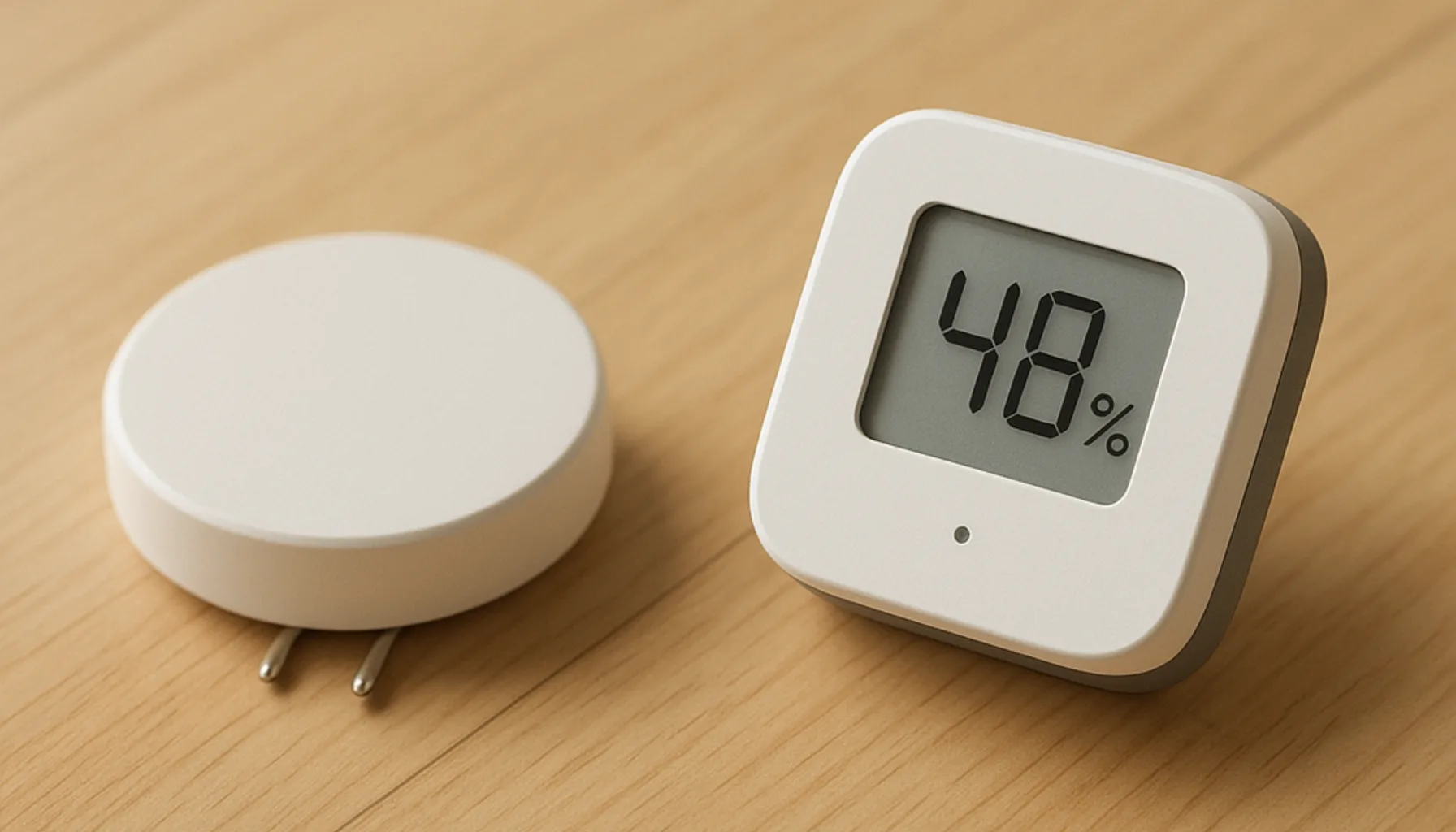
Short answer: a water leak sensor and a humidity sensor do two different jobs, and most homes genuinely need both. A leak sensor sits on the floor and detects water contact — it is your flood alarm for the kitchen sink, washing machine and boiler. A humidity sensor sits on a shelf and detects water in the air — it is your damp and condensation monitor for bathrooms, basements and utility rooms. We run both: the Aqara Water Leak Sensor T1 for the leak spots and the SONOFF SNZB-02D for room climate. Pick one by matching it to the job, not by price.
What we run
Our 46-device Zigbee network (Sonoff ZBDongle-E coordinator, Zigbee2MQTT) includes both sensor types, and they serve completely different corners of the house:
- SONOFF SNZB-02D — the temperature and humidity sensor we document in our best humidity sensor guide. It measures air conditions and reports %RH changes over time. We use it for room climate and condensation warning.
- Aqara Water Leak Sensor T1 — the best water leak sensor pick. It sits flat on the floor and reads near-zero resistance between two probes; when water bridges them, it reports “wet”. We use it for flood detection at the failure points.
To be straight about honesty: the SNZB-02D is a documented, long-running part of our climate setup. The Aqara T1 we rank from its specs, review matrix and the ZHA/Zigbee2MQTT pairing path we already run for other Aqara sensors — we have not yet logged a full year of 24/7 data on that exact unit. What neither sensor does is the other’s job, and that is exactly the point of this guide.
Leak sensor vs humidity sensor: the core difference
The one line that clears up 90% of the confusion:
- Leak sensor = water on the floor. It detects contact with a liquid between its probes. It does not care about the air in the room.
- Humidity sensor = water in the air. It measures relative humidity and temperature. It has no idea whether the floor is wet.
That difference decides everything downstream. A leak sensor gives you an instant, binary “wet or dry” signal that is perfect for an automation. A humidity sensor gives you a slow-moving percentage you read for trends — rising RH over hours tells you a bathroom is steaming up or a basement is slowly getting damp, long before any water reaches the floor.
Think of it as the difference between “the pipe burst” and “the room is getting damp”. One is an emergency, the other is a warning. Different sensors, different triggers.
When you actually need a leak sensor
A leak sensor earns its place at the exact spots where a failure means water on the floor. In most homes that is a short, specific list:
- Under the kitchen sink — the highest risk/value spot, where a slow drip hides inside a cabinet.
- Behind or under the washing machine and dishwasher — the classic flood source, and where a drip pan gives you a natural catch basin to drop the sensor in.
- Next to the boiler or water heater — utility rooms are the silent spots where leaks go unnoticed.
- Near a toilet fill valve — small, but a constant-pressure failure point.
At these spots a humidity sensor is the wrong tool: by the time airborne moisture tells you something is wrong, the water is already spreading. The leak sensor’s probe-based trigger is what makes a real flood automation possible — Home Assistant sees “wet”, sends a critical notification, and (if you wired it) shuts off a valve or kills power. The full wiring is in our water leak sensor guide.
One honest caveat: a leak sensor detects contact, not volume. It tells you there is water, not how much. For slow moisture buildup that never reaches a probe, a leak sensor on its own will stay silent — which is where the next sensor type steps in.
When a humidity sensor is the right tool
A humidity sensor earns its place where the problem is in the air, not on the floor:
- Bathroom — condensation and mould risk from showers.
- Basement — slow damp that a probe never touches.
- Utility/laundry room — drying washing pushes humidity up before any leak appears.
- Bedroom — comfort and dew-point awareness for sleep quality.
Here a leak sensor is useless: it sits on a shelf measuring air, and no water ever touches its probes. The humidity sensor’s real value is trends. A steady rise in %RH over hours tells Home Assistant to trigger a dehumidifier, an exhaust fan, or a “windows are open, it’s raining outside” style check — well before condensation forms. On our network we log this via Zigbee2MQTT and act on the trend, not on a single reading.
The SONOFF SNZB-02D is our pick here because it pairs instantly with ZHA or Zigbee2MQTT, has a display for at-a-glance reading, and its ±0.2 °C / ±2 %RH spec is honest for the price. For pure room climate, that is the tool you want — not a flood sensor sitting on a shelf doing nothing.
Where to put each one
Builders think in placement, so here is the no-nonsense map:
| Spot | Sensor | Why |
|---|---|---|
| Under kitchen sink | Leak | Water lands on the floor inside a cabinet |
| Behind washer/dishwasher | Leak | Flood source; drop in the drip pan |
| Boiler / water heater | Leak | Silent failure point |
| Bathroom | Humidity | Condensation, not flooding |
| Basement | Humidity | Slow airborne damp |
| Bedroom / utility | Humidity | Comfort + trend monitoring |
The short version: put the leak sensor flat on its back so the probes face the floor, and put the humidity sensor on a shelf or wall where air flows freely — away from direct steam, radiators and open windows. Two sensors, two placements, zero overlap.
Verdict
Buy the Aqara Water Leak Sensor T1 for the flood spots and the SONOFF SNZB-02D for room climate, and you have both jobs covered with two cheap, local, Zigbee devices. They are not alternatives — a leak sensor protects the floor, a humidity sensor protects the air. Pick by matching the sensor to the spot, wire the leak sensor into a real automation, and let the humidity sensor watch the trends.
Prices and availability checked 2026-10-19. Commissions are earned from qualifying purchases — see our affiliate disclosure.