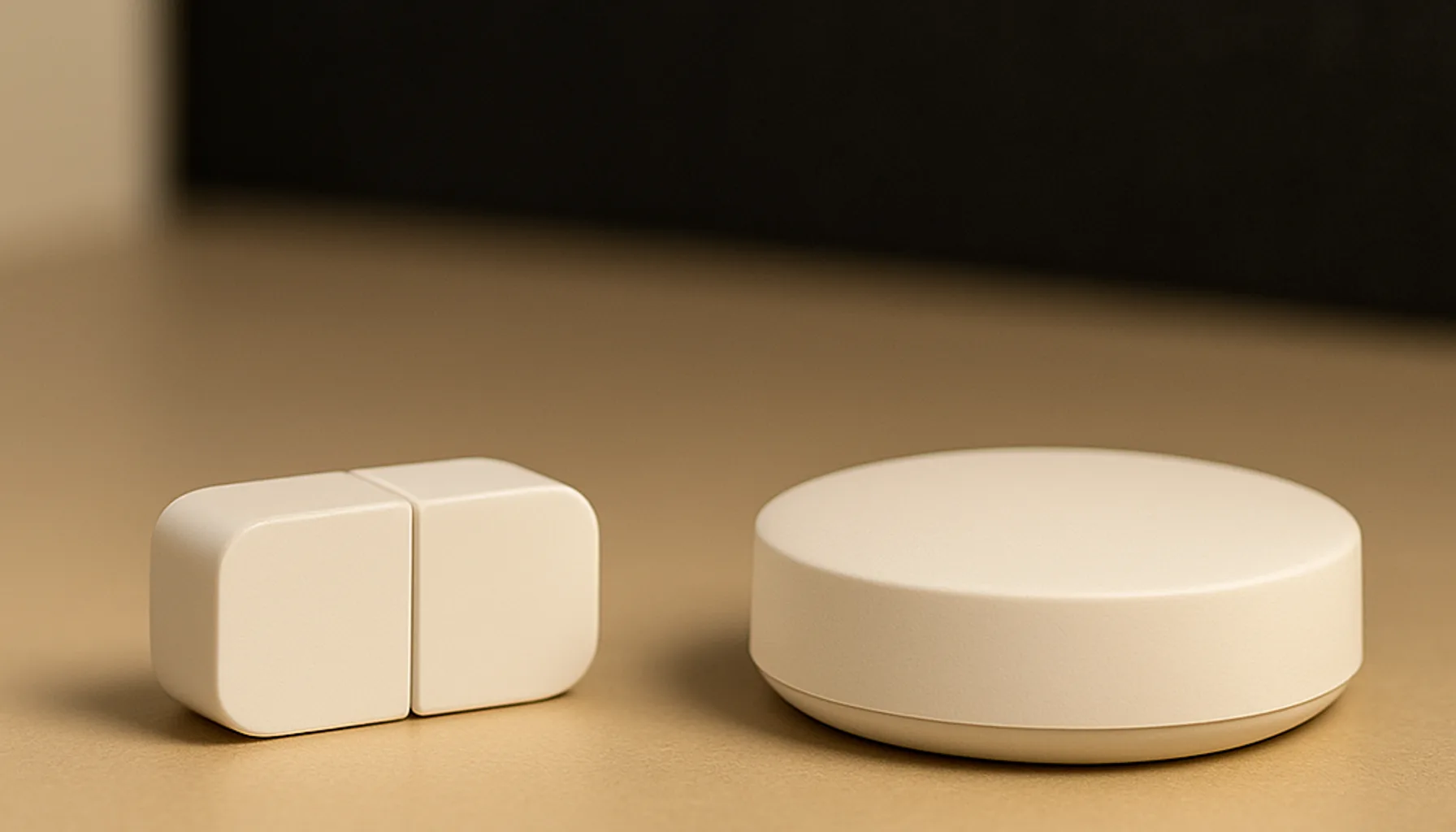
Short answer: the Aqara Door and Window Sensor answers “is the door open or closed?” — instantly and reliably on battery. The Aqara Vibration Sensor answers a different question: “did this object move, tilt or get knocked?” For most Home Assistant setups in 2026, buy the door sensor for anything that opens and closes, and the vibration sensor only when you need to detect motion on a thing that doesn’t open. The door sensor is the better default for ~85% of use cases; the vibration sensor earns its price on gates, mailboxes and drawers where contact makes no sense.
What each sensor actually detects
Both are small, battery-powered Zigbee 3.0 devices from Aqara that pair directly with ZHA or Zigbee2MQTT — no hub, no cloud. That’s where the similarity ends.
The door/window sensor (MCCGQ11LM) is two halves held together by a magnet. It reports a binary state: the reed switch is closed when the halves are touching, open when they’re apart. That makes it a genuinely instant open/closed sensor — ideal for “the door is ajar”, “the window stayed open”, “the gate closed”. It wakes only on change, which is why its CR2032 typically lasts over a year.
The vibration sensor (DJT11LM) is a single unit with an accelerometer. It reports three different triggers — vibration, tilt, and drop — on any object it’s stuck to. It answers “did something move here?” where there is no hinge and no magnet: a gate that slides, a mailbox lid, a chest, a workbench drawer, or detecting a knock.
Where the door sensor is the right tool
- Doors and windows you want to know the state of — open/closed is inherently binary, and this sensor nails it with zero fuss.
- Garage / front / back doors — the classic. On our garage door it reports closed within a second over Zigbee, and we trust that state in automations.
- Security basics — “back door opened at 02:00” or “window left open when I left”.
- Battery and cost efficiency — one CR2032 that outlives most projects, at roughly €12–15 per unit, two magnets, done.
If your use case fits “I need to know whether this openable thing is open”, the door sensor is almost always the correct and cheaper answer.
Where the vibration sensor earns its place
- Gates and sliding doors — a gate rolls sideways; there’s no hinge gap for a two-part magnet sensor. Vibration/tilt is how you know it actually moved (this is exactly how we detect gate motion in our garage build).
- Mailbox ping — “mail has arrived” without a camera pointed at the street.
- Drawers, cabinets, chests — “someone opened the toolbox” or “the safe was touched”.
- Detecting a knock or impact — a soft knock or a strike registers, which a contact sensor can’t see at all.
The honest caveat: sensitivity is its weak spot. Out of the box it can be either too twitchy (every bird landing on the gate pings) or too numb (you yank the drawer and nothing fires). You’ll spend time tuning sensitivity in the device settings, and community reviews are genuinely mixed on how tunable it feels.
Verdict table: what to buy for each job
| Job | Sensor | Why | Price (approx.) |
|---|---|---|---|
| Open/closed doors & windows | Aqara Door/Window Sensor | Instant binary state, year+ battery | €12–15 |
| Garage / front-door state | Aqara Door/Window Sensor | We run it daily on our garage door | €12–15 |
| Sliding gate / motion on the gate | Aqara Vibration Sensor | No hinge gap; detects movement + tilt | €14–18 |
| Mailbox / drawer “did something move” | Aqara Vibration Sensor | Tilt/drop/knock on any object | €14–18 |
Prices are street prices from our 2026-10-12 research; they move around, especially near sales.
What we run and what we’ve verified
On the honesty front: we have documented real-home experience with both sensors on our own Zigbee network — the door sensor on the garage-door frame and the vibration sensor for detecting gate motion, all on a Sonoff ZBDongle-E coordinator with Zigbee2MQTT in a 46-device network. That’s the ground these recommendations stand on: we’ve lived with the door sensor’s instant reliability and the vibration sensor’s tuning curve, not just read about them.
Specs we verified: both pair natively with ZHA and Zigbee2MQTT (no proprietary Aqara hub required), both report instantly on state change, and both run on the original battery for a year or more in typical use. That matches the product listings we checked on all three EU marketplaces on 2026-10-12.
The honest caveats
- The door sensor only knows open/closed. It can’t tell you the door moved without opening, and it doesn’t detect a distant knock. If your question isn’t binary, this is the wrong tool.
- The vibration sensor needs tuning. Sensitivity is the #1 complaint in reviews and our own experience — plan time to dial it in, or you’ll get false pings or missed triggers.
- Don’t buy both for the same spot. On a standard hinged door, the contact sensor is strictly superior and cheaper. Add the vibration sensor only for the specific things it can see and the contact sensor can’t.
- Both are genuinely local-first. No cloud, no subscription, works with ZHA and Zigbee2MQTT alike. That part is as good as it looks on the box.
Bottom line
Buy the Aqara Door and Window Sensor for everything that opens and closes — it’s the better, cheaper, more reliable default and we run it daily on our garage door. Add the Aqara Vibration Sensor only where you need to detect motion, tilt or a knock on something that doesn’t open: gates, mailboxes, drawers. Keeping them separate is the whole point of this guide — reach for the contact sensor for state, and the vibration sensor for movement, and pair either on a Sonoff ZBDongle-E with Zigbee2MQTT or ZHA.
Prices and availability checked 2026-10-12. Commissions are earned from qualifying purchases — see our affiliate disclosure.