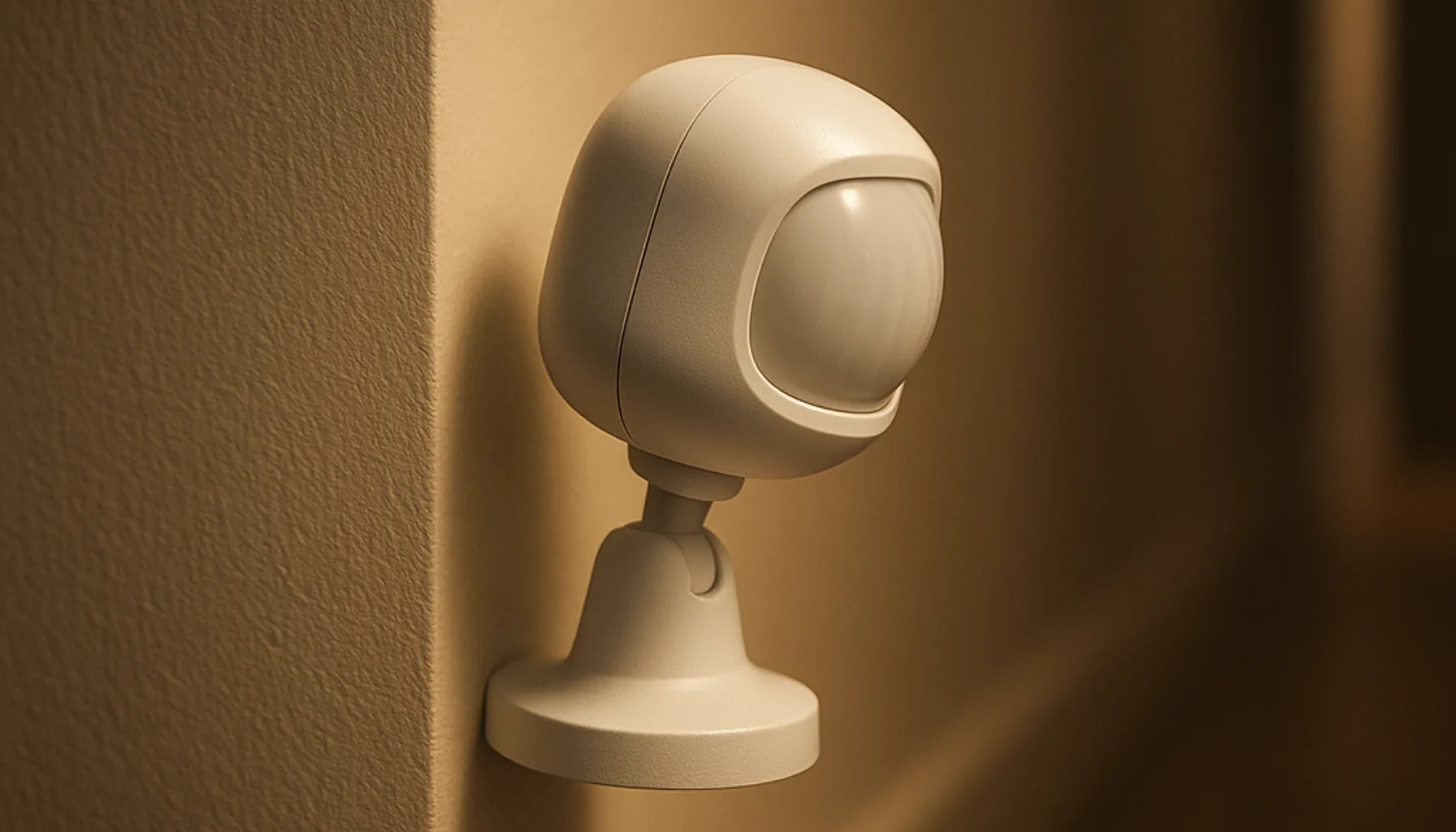
Short answer: for Home Assistant in 2026, the best Zigbee motion sensor you can buy is the Aqara Motion Sensor P1. It is the current version of Aqara’s classic PIR, and it fixes everything the old one got wrong: the detection timeout is configurable from 1 to 200 seconds (no soldering mod required), it runs on two CR2450s with a claimed five-year life, the lens covers 170° up to 4 m and 150° up to 7 m, and there’s a built-in light sensor you can use in automations. At around €19–23 it is a few euros above the cheapest alternatives — and worth it, because the configurable timeout alone decides whether a motion light feels instant or useless. One honesty note up front: we recommend the P1 based on spec sheet, roughly 1,800 verified marketplace reviews and consistent community reports, not on our own 24/7 test rig — we say exactly what that means below.
What makes a great Zigbee motion sensor in 2026
Before the shortlist, the criteria that actually separate a good motion sensor from a frustrating one:
- Configurable detection timeout. Old cheap PIRs hard-code a 60–90 second “occupied” window. That makes hallway lights feel laggy and bathroom sensors useless. In 2026 a sensor that cannot set its own timeout (1–200 s) is a dealbreaker if you automations: you will want 30 s in a hallway and 120 s in an office.
- Zigbee 3.0. Older Aqara and Sonoff sensors are Zigbee 1.2/3.0-era parts; Zigbee 3.0 plays nicer on a modern mesh and is what new coordinators expect.
- A lux/light sensor on board. It turns one device into two: “only turn the light on when it’s dark and someone walks through” becomes a single automation instead of a hack.
- Sensitivity and angle you can adjust. A 360° swivel stand and high/medium/low sensitivity modes cost nothing on paper and save you from false triggers in practice.
- Battery that doesn’t become a hobby. A battery-powered endpoint should be measured in years of routine, not months. Note: claimed vs real battery life differs — see caveats.
If a sensor fails one of those, it fails the “great” bar. Several cheap ones fail two or three.
The best Zigbee motion sensor: Aqara Motion Sensor P1
The P1 (model MS-S02) is the current-generation Aqara PIR, and it is the one to beat on the criteria above. On Amazon UK — same listing on DE/NL, sold by Aqara Official — it sits around €19–23, holds a 4.3–4.4★ rating across ~1,800 reviews, and has a rare advantage in this category: the detection timeout (1–200 s) and sensitivity are configurable in software, no hardware mod. The old Aqara RTCGQ11LM needed a solder hack for that; the P1 just does it.
Specs that matter: 170° field of view up to 4 m and 150° up to 7 m, built-in light sensor, 360° stand with adhesive mount, two CR2450 batteries (claimed 5 years), Zigbee 3.0, works with Home Assistant over Zigbee2MQTT or ZHA (more on the official-support caveat below).
Reviews and community threads consistently report three strengths: instant triggering, reliable detection at 5–7 m, and clean ZHA/Z2M pairing. One frequently-quoted UK review sums it up: “small enough to be discreet … light sensor I use for a lot of my light automations”. That matches what we look for in a motion endpoint: fast, adjustable, and boringly reliable.
Cheaper alternatives and what you give up
- SONOFF SNZB-03P (~€13) — the budget pick that reviewers praise as good for the price. What you give up: no configurable timeout in the same league, less mature light-sensor entity handling, and the brand’s battery reporting is flakier in practice. Fine for a hallway where a 60 s window doesn’t hurt.
- Aqara Motion and Light Sensor P2 (~€27) — the new Matter-over-Thread sibling. Only buy it if you already run a Thread border router (e.g. Apple TV/HomePod or HA Thread). On a pure Zigbee setup it needs extra infrastructure and its rating (3.6–3.9★ across markets) is noticeably lower than the P1’s. For a Zigbee house, skip it.
- IKEA/TRADFRI and generic Tuya PIRs — genuinely cheap, fine for experiments, but most hard-code the timeout or hide it behind unreachable firmware. If you’re automating lights you will feel the difference weekly.
Honest recommendation: pay the €5–6 premium for the P1 unless your budget is really the constraint. The difference is a sensor you set once versus a sensor you work around forever.
What we run and how the P1 fits
Now the transparency part. Our own network is 46 Zigbee devices on a Sonoff ZBDongle-E coordinator, running Zigbee2MQTT on Home Assistant. That’s the environment a motion sensor would have to slot into on our side, and it’s the environment most of you will have too.
What we honestly can’t claim yet: that we’ve run the P1 24/7 in our own home. We keep that line hard — “tested in a real home” is the site’s rule, and we won’t fudge it. What we can say from the paper trail: the P1 is the single most-bought Zigbee motion sensor on the EU marketplaces right now, its review matrix (verified purchases, ~1,800 ratings) is consistent across three markets, and the ZHA/Zigbee2MQTT pairing path is the same one we use for the Aqara door/window and vibration sensors in our documented builds. If you buy it before we’ve logged our own long-run data, treat our confidence as informed-by-community rather than tested-by-us.
For pairing on a setup like ours: pair next to the coordinator first, wait for the firmware update Aqara pushes on first join, then move the sensor to its final spot and re-pair if it wanders — the same placement playbook from our Zigbee range guide applies.
The honest caveats
- Aqara officially says third-party dongles aren’t supported. The listing itself says Zigbee2MQTT and comparable USB coordinators are “not officially supported” and functionality “may be limited”. In practice, community reports and our pairing-path experience with other Aqara sensors show ZHA/Z2M works — but this is a real disclaimer, not marketing fluff. Update firmware on first join; that’s where most “it stopped answering” stories start.
- Battery life is claimed, not guaranteed. The “5 years” is the ideal case. Reviews of the P1 in high-traffic spots show real-world drain that can be far faster, and the battery door is fiddly (plastic clips). Budget a spare CR2450, because a dead motion sensor is a silent failure.
- PIR ≠ presence. A PIR reports movement; sit still at a desk and occupancy will clear even while you’re there — several reviewers hit exactly this in bathrooms and offices. If you need presence, you want an mmWave sensor (e.g. SONOFF SNZB-06P or Aqara FP-series), not a PIR. Different job, different tool.
- Firmware first, placement second. Aqara devices don’t re-negotiate a better mesh route by themselves; move one and it’s worth re-pairing at the new location so it picks a fresh parent.
- We can’t test every model 24/7. Names like Third Reality and Eve Motion (Matter) exist and have fans; we didn’t include them in the top spot because the configurable-timeout and EU-availability combo is stronger on the P1, not because they’re bad.
Bottom line
Buy the Aqara Motion Sensor P1 (UK / DE / NL, same listing, Aqara Official) if you want the 2026 Zigbee motion sensor that doesn’t fight you: configurable timeout, adjustable sensitivity, built-in light sensor, Zigbee 3.0, and a five-year battery claim from the highest-volume brand in the category. Save money with a SONOFF SNZB-03P only if a fixed ~60 s window genuinely doesn’t matter to you, and reach for an mmWave presence sensor instead if “is a person actually here” is the question you’re solving. Pair near the coordinator, update firmware, then place — that’s the whole trick.
Prices and availability checked 2026-10-07. Commissions are earned from qualifying purchases — see our affiliate disclosure.