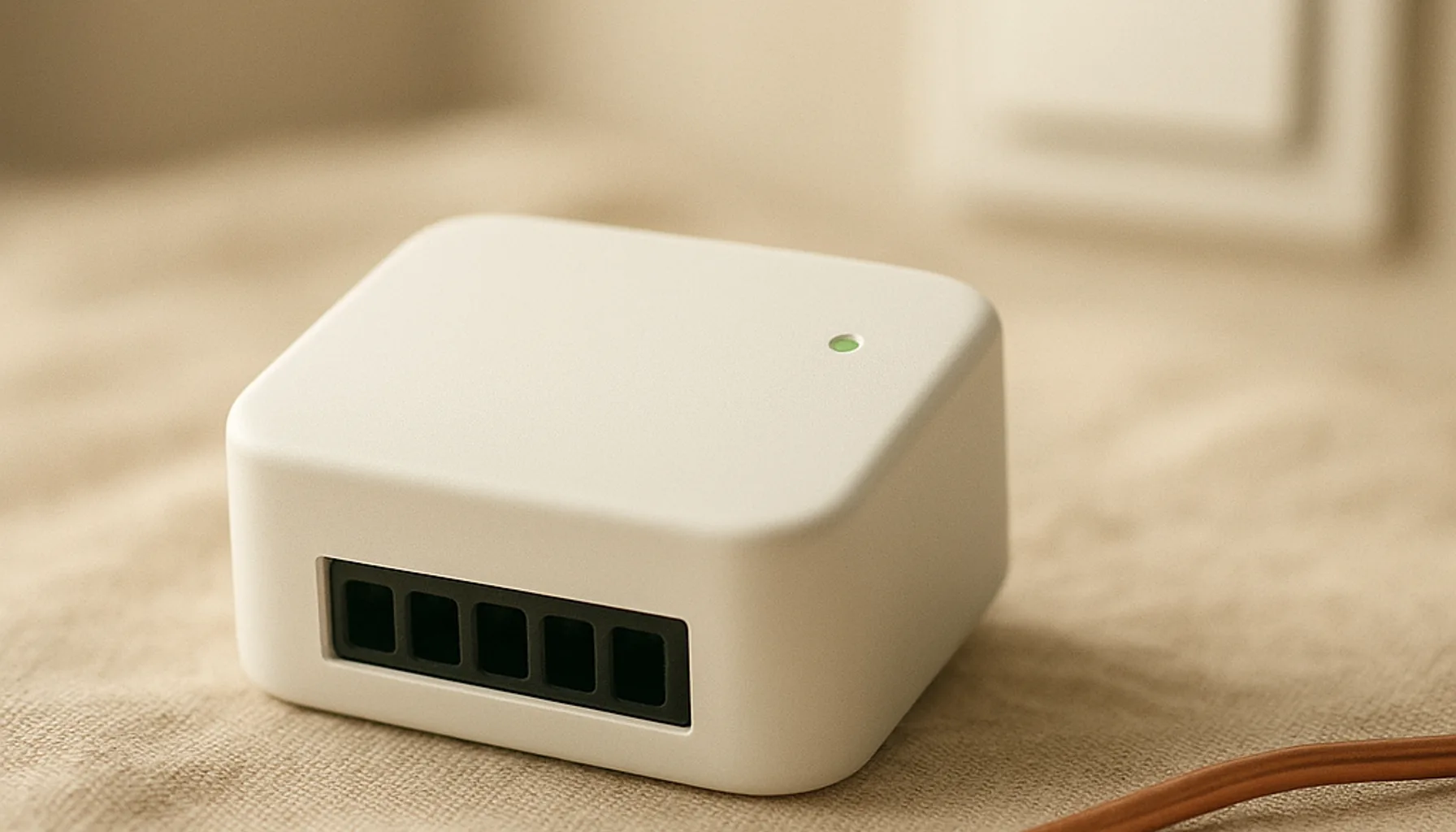
Short answer: the best Zigbee switch for a wall box without a neutral wire in 2026 is the SONOFF ZBMINI-L2 (ZBMINIL2). It’s a relay module, not a wall plate: it hides behind your existing rocker switch, runs on live wire only, measures 39.5 × 32 × 18.4 mm, and pairs with Zigbee2MQTT or ZHA without any hub. It is rated 6A / 1440W at 100–240V, so it covers lighting and light loads, not sockets. Two honest caveats before you order: the listing linked here is a 4-pack (one module per light circuit), and this module cannot dim and cannot reverse your switch direction in software. In plain terms — if your house was wired before neutrals came to the switch boxes, this is the device that finally makes those lights smart, and if your house does have neutrals, you should buy something else and save yourself the load limits.
What “no neutral wire” actually means
Let’s keep it simple, because this is the one concept that decides your whole shopping list. A light circuit needs two wires: live (phase) and neutral. In older European homes the neutral was run straight from the ceiling rose to the lamp, and only the live wire was dropped down to the switch. So behind your switch there is one wire, not two.
A smart switch needs a tiny bit of power to run its radio — even when the lamp is off. If there’s no neutral to steal it from, the module has to draw a trickle of current through the lamp itself. That’s the whole trick behind “no neutral” devices, and it explains every limitation you’ll read about below: too small a load and the module can’t harvest enough power, some LED drivers flicker at that trickle, and a device that needs zero current at rest (a fan motor, a contactor) simply won’t work.
In our own home that’s exactly the situation in two boxes on the ground floor: the ceiling has a neutral, the switch box does not. Running a new wire through a finished wall was not on the table, so a single-live-wire module is the only option that keeps the physical switches our family actually uses.
What to check before you buy
Newcomer’s checklist, in order of how often it kills a purchase:
- Load type and size. Lighting only (resistive loads). The ZBMINI-L2 needs roughly 3W minimum on the lamp and is rated 6A / 1440W max. A single 4W LED bulb is borderline; a ceiling full of them is fine. Inductive loads like ceiling fans are out — Blakadder’s teardown review calls this out explicitly.
- Box depth. This is where modules live or die. At 39.5 × 32 × 18.4 mm the L2 fits a standard 63mm EU box next to the wiring; older shallow boxes are still tight. Measure before you commit.
- Neutral or not — read the model number twice. SONOFF sells
ZBMINIL2(no neutral, what this guide is about) andZBMINIR2(neutral required, plus router function). They look alike and the R2 often ranks higher in searches. Buying the wrong one is the single most common mistake in this category. - Switch type. The module works with a classic rocker and with a momentary push-button; you switch modes with three short presses on the device button. Your existing rocker stays on the wall and keeps working — that’s the point.
- Does it repeat your Zigbee mesh? The ZBMINIL2 is an end device and cannot act as a Zigbee router, per the Zigbee2MQTT device page. Mains-powered usually means “router”, so this is a genuine exception worth knowing: it switches, it doesn’t strengthen your network.
- Decoupling. Can the module report the switch press separately from toggling the relay? On the L2 it cannot — press and relay are bound together. If you want “press does nothing, the smart bulb decides”, you need a module with detached-relay mode instead.
The shortlist
| Option | Neutral needed | Rating | Zigbee2MQTT / ZHA | Dimming | Best for |
|---|---|---|---|---|---|
| SONOFF ZBMINI-L2 (ZBMINIL2) | No | 6A / 1440W | Yes, hub-free | No | old EU boxes, on/off lights |
| SONOFF ZBMINIR2 | Yes | 10A class | Yes | No | boxes with neutral, mesh router |
| No-neutral wall plate (e.g. Aqara H1 no-neutral) | No | ~5A | Usually yes | No | when you want a new faceplate too |
| Smart bulb instead | — | — | Yes | Yes | lamps you never switch off at the wall |
| Leave it dumb + smart plug | — | 16A | Yes | No | floor lamps, not ceiling lights |
The L2 wins the bracket for one boring reason: it is the smallest single-live-wire Zigbee relay with a clean EU listing, official Zigbee2MQTT support and no hub tax. The alternatives aren’t worse products — they’re different products. A no-neutral wall plate is the better buy if you also want to replace ugly switches; a smart bulb is the better buy if the switch can stay permanently on. The module is what you choose when the switch must stay, the wiring must stay, and the lamp just has to become smart.
What we run and what’s honest here
Our real-home network is 46 Zigbee devices on Zigbee2MQTT in Home Assistant, and the switching side of that network is our daily reality — pairing, groups, power_on_behavior, automations that survive a HA restart. The ZBMINI-L2 is the module we picked for our two no-neutral boxes precisely because it pairs on the standard path instead of needing a vendor bridge.
But let’s be straight with you about the limits of this article: we have not yet screwed the L2 into our own wall box. The wiring details, the 6A rating, the 3W minimum load and the missing detached-relay mode in this guide come from the official SONOFF spec, the Zigbee2MQTT device page and Blakadder’s hands-on teardown — documented sources, not our own screwdriver. Anything labelled “in our home” below is about the Zigbee/Home Assistant half, which we do run every day. We’d rather say that than sell you a fantasy test.
Installing it behind an existing switch
The schematic is four terminals: Lin (incoming live), Lout (to the lamp), and S1 / S2 for your physical switch. Practically:
- Kill the breaker and verify it’s dead with a tester at the switch. No exceptions, no “it’s probably the right one”.
- Photograph the existing wiring before you disconnect anything. You will be glad you did.
- Live into Lin, the wire to the lamp into Lout, the two switch wires into S1 and S2. Those S1/S2 terminals sit on mains potential, so use switches rated for it — a low-voltage bell push is not acceptable.
- Tuck the module into the box, restore power, and check that the physical rocker still toggles the lamp. It should, before you even pair anything.
- If you have a momentary push-button instead of a rocker, switch the mode with three short presses (green LED blinks three times). Same trick if the switch direction feels inverted.
For the 2-way case (two switches on one lamp) the module goes into one of the two boxes and both wall switches keep working — that’s the “two-way control” the manual advertises. Multi-way setups with changeover wiring are the one case where you want an electrician’s eyes on it.
Pairing with Zigbee2MQTT or ZHA
Out of the box the device is already in pairing mode; to re-pair, hold the button five seconds until the green LED blinks slowly. The alternative reset path matters if the module is already buried behind a faceplate: toggle the external switch ten times in a row (documented on the Zigbee2MQTT page) and it enters pairing without you touching the device.
Once paired you get two useful entities: switch.state and power_on_behavior (off / on / toggle / previous). That second one is not decoration — after a power cut, “previous” is what stops your hallway light from coming on at 3 a.m. Set it explicitly. OTA firmware updates are supported, so the module can be updated over the air later without pulling it out of the wall.
Pair it next to your coordinator first, then move it into the box, exactly like any other end device — the same playbook as our range guide. And remember the mesh point from above: because this module is not a router, a house full of L2s adds convenience but no coverage.
The catch: what a no-neutral module can’t do
- No dimming. On/off only. There are no-neutral Zigbee dimmers, but they’re a different device class with their own flicker problems — don’t expect the L2 to grow that feature.
- Minimum load is real. Under ~3W some lamps won’t let the module boot reliably. A single dim LED bulb is the classic failure case.
- No inductive loads. Fans, extractor motors, contactors: no. Resistive lighting: yes.
- Not a router. Your mesh does not get stronger. Plan repeaters separately — our router shortlist exists for that.
- Switch and relay are married. Pressing the rocker physically cuts power to the lamp. With a smart bulb behind it, that means the bulb drops off the network every time someone flips the switch — the classic smart-home trap.
- 4-pack economics. The EU listing is a four-pack, which is fine value if you have four boxes to do and slightly annoying if you only have one. Single units are sometimes sold by third parties.
- It’s a DIY install inside a mains box. If you’re not comfortable working dead-circuit wiring, this is a job for an electrician. That’s not a disclaimer to skim — it’s the honest answer.
Bottom line
The SONOFF ZBMINI-L2 (ZBMINIL2) is the best Zigbee switch without a neutral wire in 2026 because it solves an electrical problem rather than a gadget problem: no new cable, no new faceplate, existing switches keep working, and it pairs on the standard Zigbee path with Zigbee2MQTT and ZHA. At roughly €13–15 per module it’s cheap, and it’s tiny enough to fit boxes that other relays can’t.
It’s a 4.0 and not higher for four concrete reasons: no dimming, no detached-relay mode, no router function, and a 3W minimum load that rules out some single-bulb circuits. For on/off ceiling lights in an old installation it’s the right tool. For anything else — a dimmable lamp, a fan, a box where you do have a neutral — buy a different device, and check our Zigbee starter guide first so the coordinator side is sorted before the modules arrive.
Sources: SONOFF ZBMINI-L2 specifications and manual (ITEAD); Zigbee2MQTT device page for ZBMINIL2 (pairing, exposes, end-device note); Blakadder, “Sonoff ZBMINIL2 Extreme No Neutral Zigbee Smart Switch Review” (dimensions, load limits, inductive-load caveat). Affiliate links are tagged; see the disclosure note on this page.