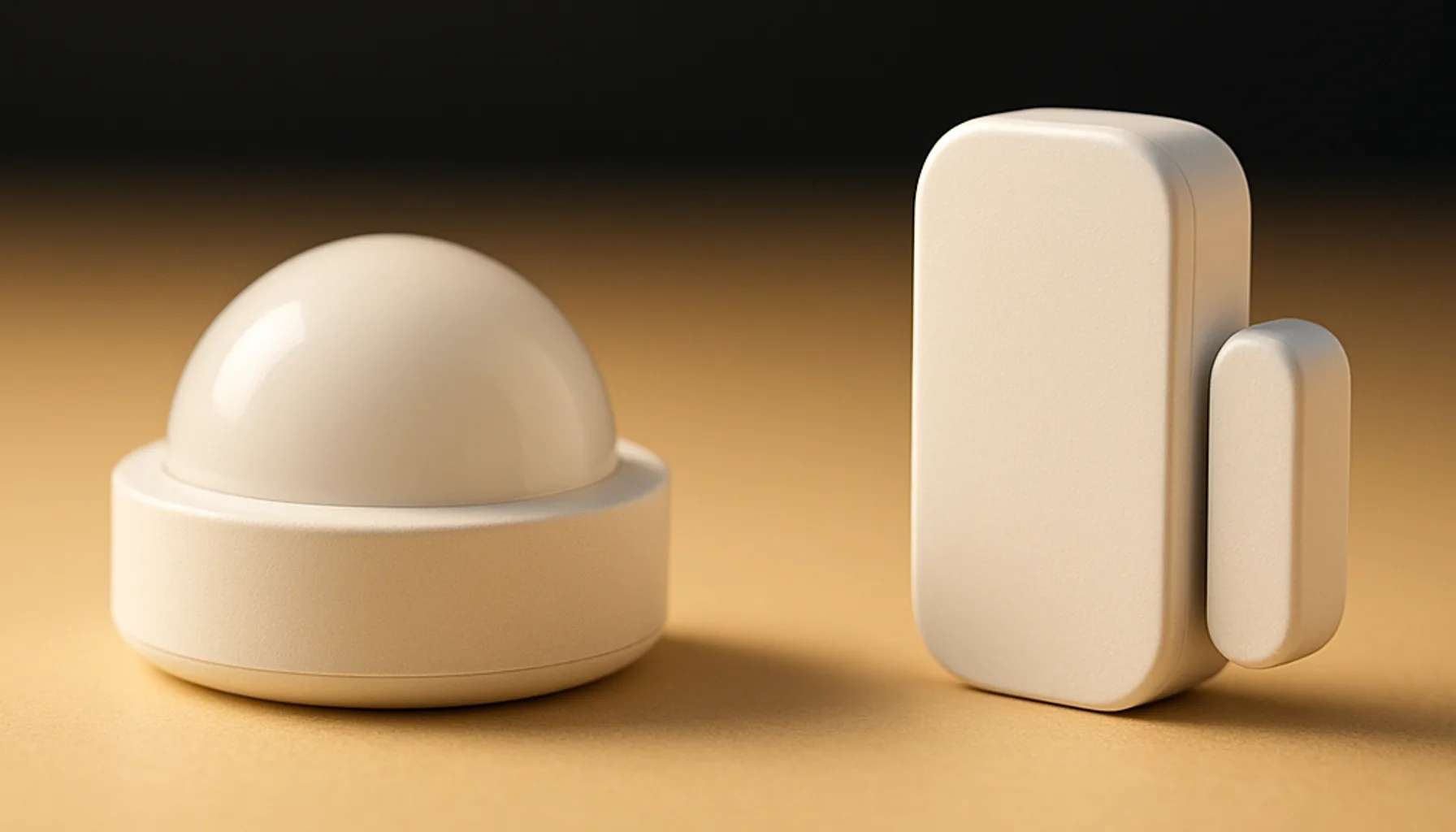
Short answer: a motion sensor and a door sensor are not interchangeable, and the marketing tries hard to blur the line. A door sensor tells you a specific opening changed state — something moved through that exact door or window. A motion sensor tells you something moved inside a room. For a Home Assistant security setup you usually want both, but the honest answer is that most buyers reach for a motion sensor first and it’s often the wrong first buy. Here’s the real distinction and the catch with each.
Motion sensor vs door sensor: what each actually detects
Let’s start with the claim, then the reality.
- Door sensor (“contact sensor”): a magnet and a reed switch report open/closed as a binary state. The catch many listings hide: it only detects that specific opening. It is blind to anything happening elsewhere in the room.
- Motion sensor (PIR): detects infrared changes across a field of view. The catch: it catches movement, not presence — a still person, a cat sunning itself, or a slow crawler can easily vanish from a PIR’s view.
The practical consequence: a door sensor is a guaranteed event (the door physically opened), while a motion sensor is an inference (something that radiates heat moved). One is deterministic; the other is probabilistic. That distinction drives every decision below.
What we run
Our 46-device Zigbee network runs both types, and they earn different corners of the house. On the coordination side we use a Sonoff ZBDongle-E with Zigbee2MQTT; on the sensing side the two relevant units are the Aqara Motion Sensor P1 and the Aqara Door & Window Sensor.
Honesty first: the Aqara door/window sensor is a documented, long-running part of our builds — we detail it in our door & window sensor guide. The Motion P1 we rank from its spec sheet, the review matrix and the same ZHA/Z2M pairing path we use for other Aqara sensors, but we haven’t logged a full year of 24/7 data on that exact unit. What I can tell you from long home use of both sensor types: the strengths and blind spots below are real, not theoretical.
When a door sensor is the right call
A door sensor is the skeptic’s favourite because it doesn’t lie. If the front door is closed, the state is “closed”. That creates automations you can actually trust:
- Entry and exit detection — you know the front door opened, so the lights, the alarm and the “I’m home” logic run on a deterministic trigger.
- Window protection — a window sensor tells you a specific window opened, even if nothing moved in front of a PIR.
- Persistence — it holds its state; it doesn’t “reset” after X seconds like a motion sensor’s timeout.
The catch: it covers one point. You need several to cover several points, and it tells you nothing about activity inside the room once the door is shut. For a single-“point-of-entry” security question, it’s the right and honest answer.
When a motion sensor is the right call
A motion sensor earns its place where presence inside a room is the question, and where a door won’t help:
- Room occupancy — someone is sitting at a desk; no door is opening, but a PIR in the room can (mostly) tell.
- Automation of lights and scenes — movement in a hallway or bathroom triggers the right behaviour without any fixed opening being involved.
- Coverage of an area — one PIR watches a space that would otherwise need several door sensors.
The catch is the part marketing skips: PIR is about movement, not occupancy. Sit still for the sensor’s timeout and the room “goes empty”. The Aqara Motion P1 has an adjustable timeout (1–200 s) and an embedded light sensor, which genuinely helps, but it cannot fix the fundamental blind spot — still bodies don’t trigger passive infrared. If presence-when-immobile matters, that’s an mmWave sensor’s job, not a PIR’s (see our PIR vs mmWave guide).
How to actually choose (the honest framework)
Stop choosing “motion OR door” and ask the real question: what event are you trying to detect?
- “Did a specific opening move?” → door sensor. No debate.
- “Is a general area occupied/moving?” → motion sensor, accepting the still-body gap.
- “I want reliable home security and don’t want to trust one sensor type with it.” → buy both. This is the honest answer for most people, and it’s why we run both. A door sensor on the entrance plus a motion sensor in the main corridor covers the two failure modes of each.
The pricing also makes “both” cheap in practice — a typical Aqara door or motion sensor sits at comparable low price points, so the “one or the other” framing is usually false economy.
The honest caveats
- Neither is a security system on its own. A door sensor on the front door plus a PIR says “something moved”; it doesn’t stop, deter or record. Treat them as tripwires for automations, not as a burglar alarm.
- Aqara official-support caveat: Aqara listings note their sensors are “not officially supported” on third-party Zigbee dongles / Zigbee2MQTT, even though they pair fine via ZHA and Z2M in practice. Read that warning as Aqara’s support policy, not a technical lock.
- PIR placement is everything. Aim it across the path a body would take, not at a heat source; the P1’s light sensor also needs sensible placement or its lux readings get meaningless.
- Battery and update quirks. Both are battery devices — budget a refresh cycle, and pair near the coordinator first so a firmware update is easy before final placement.
- Don’t over-alarm. A door sensor on a frequently-used door triggers constantly; a motion sensor in a cat household triggers on the cat. Tune automations before trusting them, or you’ll quickly learn to ignore alerts.
Verdict
Buy the Aqara Door & Window Sensor for the specific openings you care about, buy the Aqara Motion Sensor P1 for area movement, and for anything that actually matters, buy both. The “either/or” framing is a sales simplification, not engineering reality: a door sensor is deterministic and point-precise, a motion sensor is probabilistic but area-wide. Match the sensor to the event you want to detect, accept each one’s blind spot, and don’t let either one be your entire security story.
Prices and availability checked 2026-10-21. Commissions are earned from qualifying purchases — see our affiliate disclosure.