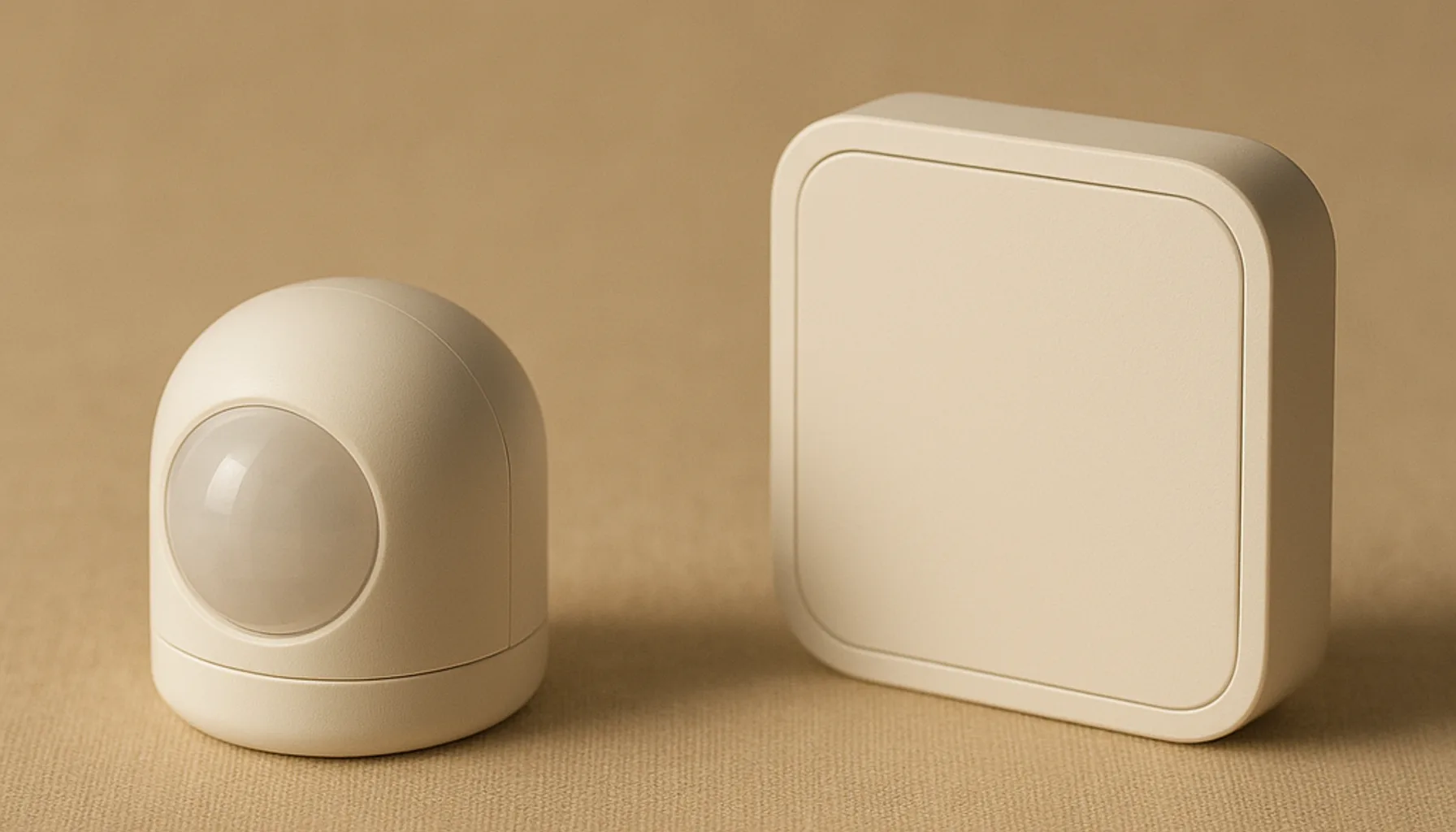
Short answer: a PIR motion sensor answers “did someone move?” — an mmWave presence sensor answers “is someone in the room, even sitting still?” For home assistant in 2026 you usually want both: a cheap battery PIR (our pick: the Aqara Motion Sensor P1) for hallways, bathrooms and entry points, and an mmWave presence sensor for desks, sofas and other spots where people sit still for half an hour. PIR wins on price, battery life and simplicity; mmWave wins on the one thing PIR fundamentally cannot do: holding a room occupied without movement. If you only buy one for a room where you sit still, buy the mmWave one — a PIR in an office will keep turning your lights off while you type.
What’s the difference: motion vs presence
PIR (passive infrared) sensors detect changes in infrared radiation — meaning movement. They are cheap (€15–25), run on coin cells for 1–5 years, and are fantastic at one job: “something moved through this space”. Their hard limit is physics, not firmware: sit perfectly still and a PIR stops seeing you, so the room reports unoccupied after its timeout (30–90 seconds on most hardware).
mmWave presence sensors use radar in the 24/60 GHz range. They bounce radio waves off the room and detect micro-movements — breathing, typing, even small posture shifts. That lets them report “occupied” while you’re completely still, which is exactly what desk, sofa and shower automations need. The trade-offs are real: most need USB/mains power (radar draws steady current), they cost roughly €25–90, and they need placement and sensitivity tuning to avoid false positives from fans, moving curtains or HVAC airflow [1][2].
When a PIR motion sensor is the right choice
- Hallways, stairs, entries, utility rooms — you need “walk through → lights on”. A PIR reacts instantly and is the cheapest reliable answer.
- Battery-powered spots — no power outlet near the sensor? PIR wins by years of battery life.
- Simple binary triggers — “someone passed”, “no one passed in the last N seconds”. If that’s the full requirement, an mmWave sensor is overkill in price and setup.
- Tight budgets or multi-sensor rollouts — you can cover a house with PIRs for the price of one mid-range mmWave unit.
Our current pick for the PIR side, the Aqara Motion Sensor P1, is the 2026 generation of Aqara’s classic PIR: Zigbee 3.0, a software-configurable detection timeout from 1–200 seconds (the old one needed a soldering mod), a built-in light sensor, and a claimed five-year battery on two CR2450s. The honest detail: we recommend it from its spec sheet, ~1,800 verified marketplace reviews and consistent community reports — we haven’t logged our own 24/7 long-run test on this exact model yet (same stance as our best motion sensor guide).
When an mmWave presence sensor is worth the money
- Home office — lights and fans stay on while you sit still at a desk, instead of PIR’s 30–90 second “abandonment”.
- Living room / sofa — “someone is on the couch” is a genuinely useful occupancy signal for scenes (dim lights, start the movie, heat follows).
- Bathroom — the classic PIR failure spot: sitting on the toilet or standing in the shower makes the light die on you. mmWave keeps it occupied (and it’s still privacy-safe — radar, not camera).
- Any room where “occupied while still” changes an automation — presence-based HVAC, away-mode, or “lights off only when the room is truly empty”.
The price premium and the power requirement are the two things to check before you commit: most mmWave units are USB-powered (Aqara FP2, Everything Presence One) or mains/USB-C (Third Reality R3, SONOFF SNZB-06P24), and only a few like the Aqara FP300 run on battery — with a shorter multi-year battery life and a PIR+radar hybrid to save power [1][2].
Shortlist: our picks on both sides
| Use case | Recommendation | Why | Price (approx.) |
|---|---|---|---|
| Hallway / entry, battery | Aqara Motion Sensor P1 (PIR) | Cheap, instant, configurable timeout, Zigbee 3.0 | €19–23 |
| Budget room presence, Zigbee | Aqara FP1E (mmWave) | Simple single-area presence over Zigbee, no Aqara account | €35–47 |
| Best overall room presence | Aqara FP2 (mmWave, Wi-Fi) | 30 zones, local HA via HomeKit Controller after setup | €65–90 |
| Open local-first tinkerer | Everything Presence One (ESPHome) | Fully local, open, mmWave + PIR + sensors in one | ~€50–70 |
| Cheapest open Z2M path | SONOFF SNZB-06P24 (mmWave, Zigbee) | 24 GHz, native ZHA/Z2M, configurable clusters | ~€25 |
Prices are street prices from our 2026-10-09 research; they move, especially around Black Friday.
What we run and what we’ve verified
Honesty section, because this is where the two technologies differ in our experience too. On the PIR/Zigbee side we have documented real-home experience: a 46-device Zigbee network on a Sonoff ZBDongle-E coordinator with Zigbee2MQTT, plus Aqara door/window and vibration sensors in our documented garage-door build. PIR-based motion detection for pass-through spaces matches what we run daily.
On the mmWave side we are explicit: we have not yet run a dedicated mmWave presence sensor 24/7 in our own home. Our picks above are research- and community-based — reviewed against multiple independent roundups and user reports that consistently describe the PIR-limitation and the fan/airflow tuning problem [1][2]. We’re not claiming a “tested in a real home” verdict for mmWave yet, and we won’t pretend otherwise; this guide tells you which job each technology does, not that we’ve lab-tested every board.
The honest caveats
- mmWave needs tuning. The #1 complaint across reviews is false positives from fans, vents, moving curtains and sometimes pets [1]. Mount away from airflow, start with conservative sensitivity, and only then tune up.
- Power is the hidden requirement. Radar draws steady current — most mmWave units expect USB or mains. If your sensor spot has no outlet, check the battery options (Aqara FP300) or fall back to PIR.
- PIR timeout is a feature, not always a bug. A 60–90 second window is fine for a hallway. The same window on a desk is why office PIRs feel broken. Pick the tool to the room, not to the brochure.
- mmWave can see through thin walls if over-cranked. A “full house present” trigger at 3 a.m. is worse than a false negative — this is the most-reported tuning failure mode [1].
- We haven’t done a long-run mmWave test yet. Treat the mmWave shortlist as informed-by-research, not tested-by-us. We’ll update the moment we have real-home data.
Bottom line
Buy a PIR motion sensor (Aqara Motion Sensor P1, UK / DE / NL) for hallways, stairs and battery-friendly spots — it’s cheap, instant, and the right tool for “movement happened here”. Buy an mmWave presence sensor (FP2 for the best all-round room presence, FP1E for simple budget Zigbee presence, Everything Presence One for fully local tinkerers, SNZB-06P24 for the cheapest open Z2M path) for desks, sofas and bathrooms where “someone is here” matters more than “someone moved”. Most homes genuinely need both; the mistake is buying either type for every room. Pick PIR for pass-through zones, mmWave for stay-still zones, and pair whatever you choose on a ZBDongle-E coordinator with Zigbee2MQTT or ZHA.
Prices and availability checked 2026-10-09. Commissions are earned from qualifying purchases — see our affiliate disclosure.