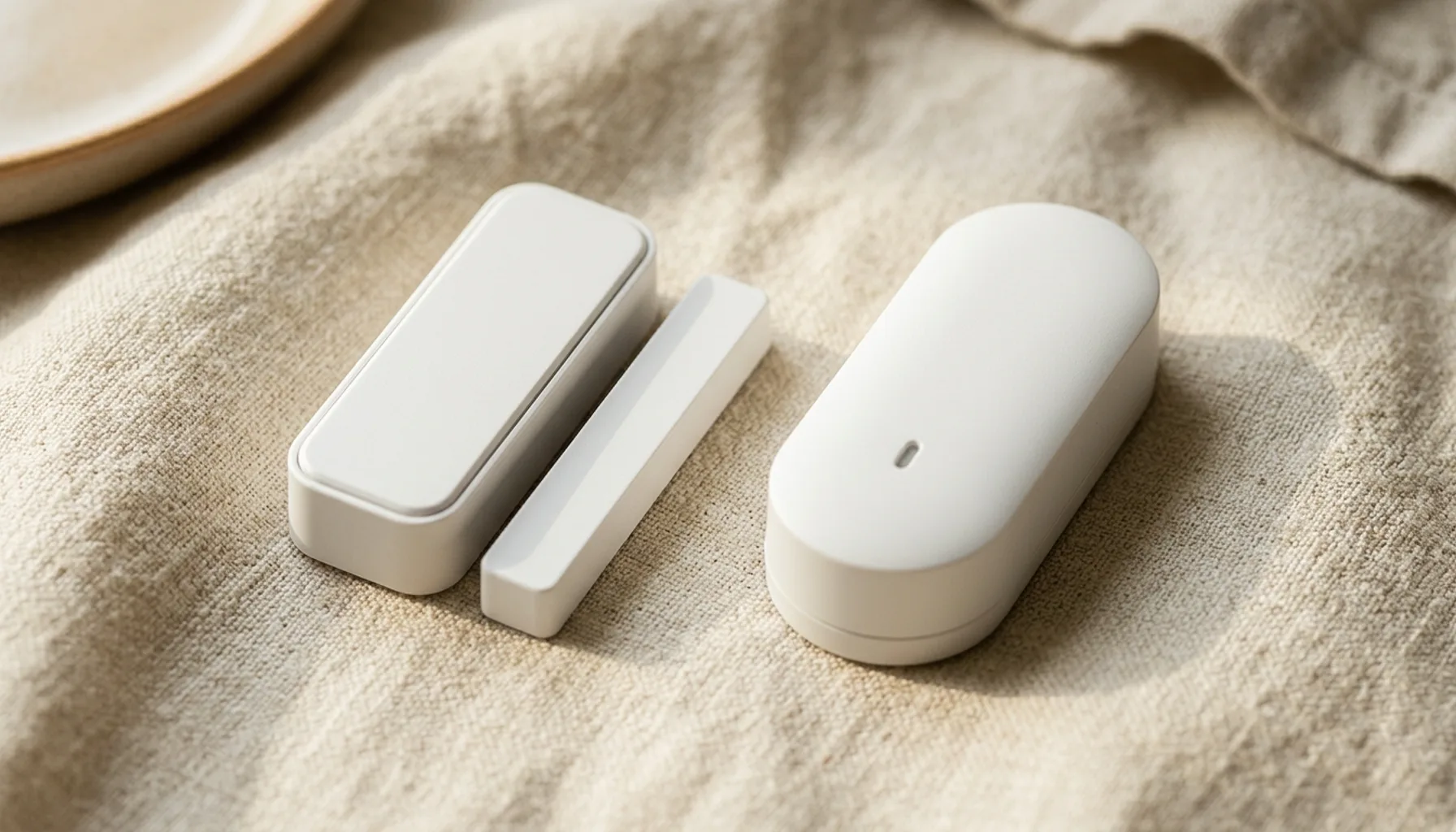
Short answer: buy Aqara when the sensor has to do something difficult — presence detection, configurable sensitivity, Apple HomeKit in the same breath as Home Assistant — and buy SONOFF when you need twenty ordinary door, window and climate sensors for the price of eight Aqara ones. Our own network runs both: Aqara for the sensors we look at every day, SONOFF for the ones we plant everywhere and forget. On the single most common purchase — a door/window contact — the SONOFF SNZB-04P wins on battery and price, while the Aqara Door and Window Sensor wins on ecosystem and HomeKit. Neither is a mistake; they are different budgets.
Below is the comparison we wish had existed when we started: what actually differs on paper, what differs in a running Zigbee network, and which brand we would buy device by device.
What we run at home
We run a 46-device Zigbee network on Zigbee2MQTT with Home Assistant, coordinated by a Sonoff ZBDongle-E. That network has both brands in it, and they behave differently in ways that are worth knowing before you spend money.
What is genuinely ours: the pairing experience, the battery replacements, the automations that fire at 02:00, the moments where a sensor silently stopped reporting and we had to go find out why. What is not ours: lab-grade radio measurements, or a multi-year failure-rate study. Where a number below comes from a manufacturer listing rather than from our own house, we say so.
The two brands on one page
| Aqara | SONOFF | |
|---|---|---|
| Device range | Door/window, motion, mmWave presence (FP2), temperature, humidity, water leak, vibration, buttons, curtain | Door/window, motion, temperature/humidity (with LCD), water leak, plugs, relays, switches, coordinators |
| Zigbee2MQTT / ZHA | Yes, direct — no Aqara hub needed | Yes, direct — no eWeLink hub needed |
| Native app | Aqara Home (cloud, hub required) | eWeLink (cloud, hub required) |
| Apple HomeKit | Yes, with an Aqara hub | No |
| Typical sensor price | €18–40 | €8–20 |
| The one thing it is known for | Sensor tech that others copy later | Being cheap, boring and available |
Both brands have a supported device page in Zigbee2MQTT, which is the single most useful pre-purchase check you can do. If a device is not on that list, no amount of marketing copy makes it a good buy for Home Assistant.
Head to head: door and window sensors
This is where most people actually choose a brand, so here is the comparison in detail. Both units were checked on all three EU marketplaces at the time of writing.
| Aqara Door & Window Sensor (MCCGQ11LM) | SONOFF SNZB-04P | |
|---|---|---|
| Zigbee | Standard Zigbee, pairs directly with Z2M/ZHA | Zigbee 3.0, pairs directly with Z2M/ZHA |
| Battery | CR1632, listing claims over 2 years | CR2477, listing claims over 5 years |
| Max magnet gap | 2.2 cm | 2 cm |
| Tamper alarm | No | Yes — app notification if the sensor is moved |
| HomeKit | With an Aqara hub | No |
| Listing rating | 4.5 / 5 (6,047 ratings) | 4.5 / 5 (768 ratings) |
| Price seen | ~€21 | ~€15 |
Read the battery column twice, because that is the real difference. The Aqara cell is a CR1632 — physically small, roughly 120–140 mAh. The SONOFF uses a CR2477, around 1000 mAh, in a case that is thicker but still fits a door frame. A door sensor wakes up for a few milliseconds per event, so battery life is essentially cell capacity divided by how often the door opens. On a hall cupboard you will never notice the difference. On a front door with four people in the house, the small cell is the reason you end up buying CR1632 cells in packs of five.
The tamper alarm on the SNZB-04P is a genuinely useful extra for a garage side door or a storage unit: if somebody pops the sensor off the frame, you get a notification instead of a silent gap in your history.
The Aqara wins on the boring-but-real point: it is the sensor everyone writes converters for. Xiaomi/Aqara quirks are documented, forum answers exist for every problem you will hit, and its state changes arrive fast enough that our garage automations react before the door has finished travelling.
What the spec sheets leave out
Aqara battery devices are sticky. This is community-documented behaviour, not a flaw we invented: Aqara end devices are known for staying attached to the router they joined through instead of re-routing freely the way Zigbee 3.0 devices do. Practical consequence: if you remove or move a router (a smart plug, a bulb) that an Aqara sensor was talking to, that sensor can drop off the mesh. The fix is simple — re-pair, or replace routers before removing them — but if you are building a network you plan to tinker with for years, budget for it.
SONOFF devices are less fussy. Zigbee 3.0 devices re-route normally. That is why our many, many cheap sensors are SONOFF: they are the ones we move around, and they come back on their own.
Needing the hub is a cloud decision, not a hardware one. Both brands will try to sell you a hub. With Zigbee2MQTT or ZHA you do not need it, and you should not buy it unless you specifically want HomeKit (Aqara) or the vendor app for a family member. Pairing either brand directly to a coordinator is a thirty-second job: hold the button, permit join, done.
“Battery life” claims are always optimistic. Five years assumes a door that opens twice a day at 20 °C. A sensor on a garden gate in a Dutch winter will not see five years from any brand. Treat the claim as a ranking, not a schedule.
Which brand for which device
- Door and window contacts → SONOFF SNZB-04P if you are buying more than two: cheaper, bigger cell, tamper alarm. Aqara MCCGQ11LM if you want HomeKit, or if your frame needs the extra 2 mm of magnet gap.
- Motion (PIR) → Aqara Motion Sensor P1. Adjustable sensitivity and a configurable cool-down make it usable for lighting automation; the cheap PIRs are fine for “is anybody in the hallway” and frustrating for anything finer. Our motion sensor guide covers the trade-off in detail.
- Presence (mmWave) → Aqara FP2, no contest. SONOFF does not compete in this category yet, and Wi-Fi vs Zigbee is the real decision there; see PIR vs mmWave.
- Temperature and humidity → SONOFF SNZB-02D. An LCD, a huge coin cell, and the accuracy we need for bathroom and office automations, at a third of the price of Aqara’s equivalent. We run several; the comparison against the alternatives lives in our temperature and humidity guide.
- Water leak → both are fine, buy whichever is in stock. Put them under the boiler and behind the washing machine, not one per room; our water leak guide explains why placement beats brand.
- Plugs, relays, switches, coordinators → SONOFF. This is not close. The ZBDongle-E is the reference coordinator of this community, and the S60ZBTPF plug is what we run behind the Christmas lights and the dehumidifier.
The honest caveats
- We have not bench-tested ten door sensors with a logic analyser. The battery chemistry and gap distances above are from the manufacturer listings; the behaviour in a live network is from our own house.
- Prices move weekly and differ per marketplace. Everything above was checked while writing and is meant as a ranking, not a quote.
- The SNZB-04P is newer to our network than the Aqara sensors, so we can confirm it pairs, reports and holds state — we cannot yet confirm the five-year claim from personal experience.
- If you own an Aqara hub and use HomeKit, buying a second brand is usually not worth the complexity, even where the specs say otherwise.
Bottom line
If you are starting out and need sensors spread through a whole house, SONOFF is the rational buy: same Zigbee2MQTT support, third of the price, bigger battery cells, and coordinators that are the de facto standard in this hobby. If you have one or two jobs where the sensor itself has to be better — presence, motion with tunable sensitivity, HomeKit — pay Aqara for those two devices and keep the rest cheap. That combination is what our network looks like after years of buying both, and it is the advice we would give a friend rather than a customer.